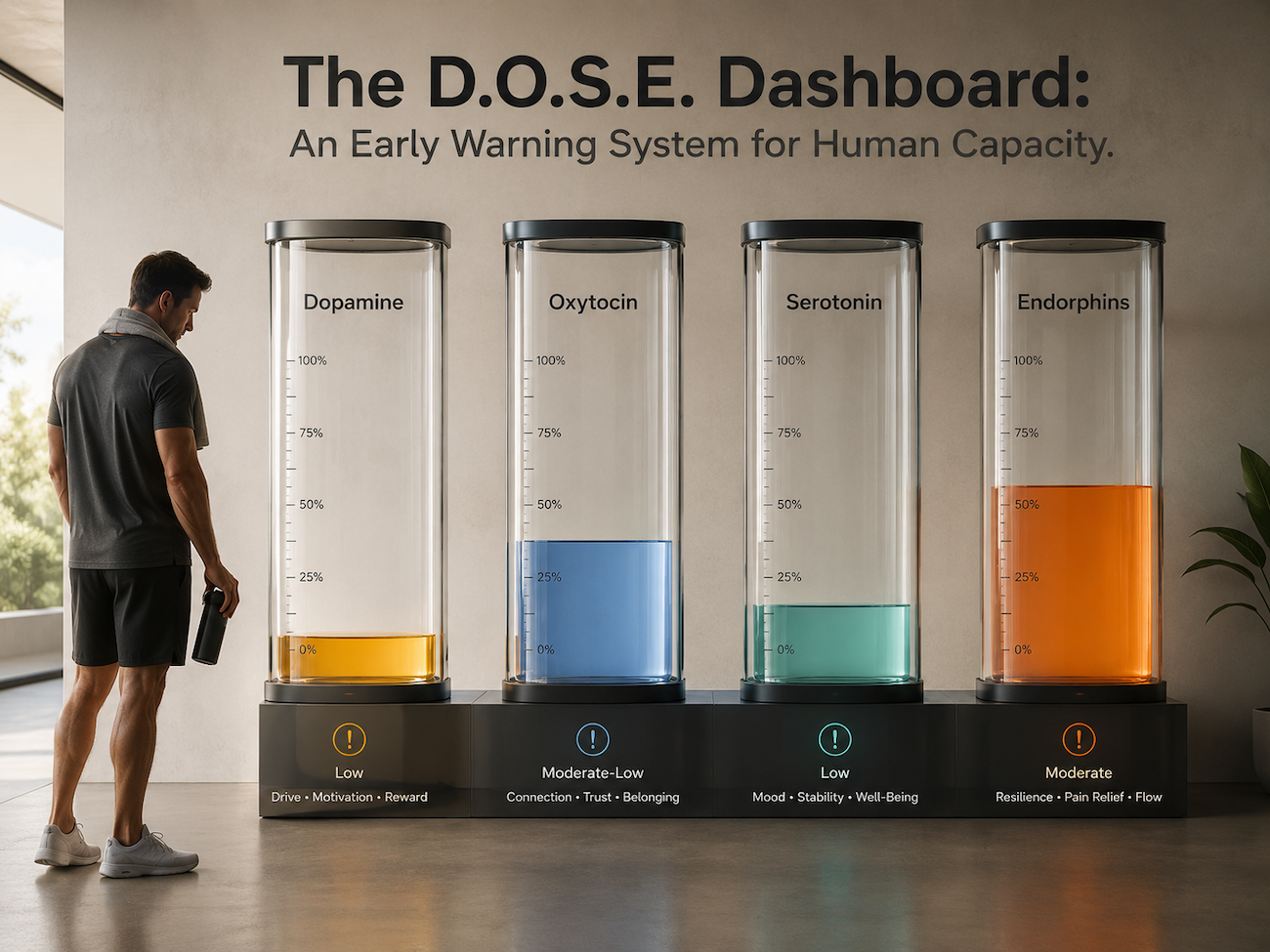
A resilience early warning system is not about waiting until you break. It is about noticing the signals that your human capacity is being depleted before the system starts to fail.
In 2021, after I had finished training, I found myself sitting outside the gym at 7am, feeling absolutely nothing. Not tired in the normal way. Not stiff. Not sore. Not even particularly dramatic. Just flat, like a phone screen that still switches on but has 1% battery, no charger and the faint smell of electrical burning.
The strange part was that, on paper, I was doing the right things. I was training. I was eating properly. I was sleeping. I had stopped drinking. I had built a routine that looked, from the outside, like discipline. And yet, there I was after a workout, waiting for the usual lift to arrive. Nothing came. The thing that normally made me feel alive had suddenly become another item on the list, another brick in the backpack, another small task in a system that was already overloaded.
That moment taught me something important: you can be disciplined and still be depleted. You can be doing the obvious “good” things and still be missing something, and you can keep performing long after the internal dashboard has started flashing. That is where D.O.S.E. becomes useful.
D.O.S.E. stands for dopamine, oxytocin, serotonin and endorphins. They are often called the “happiness chemicals”, which is helpful because it makes them easy to remember, but misleading because it makes them sound like a cute little wellness hack. They are not happiness hacks. They are part of a much bigger human capacity system, influencing motivation, connection, emotional steadiness, pain tolerance, recovery and the ability to keep going when life gets heavy. In other words, D.O.S.E. is not the fuel gauge for happiness. It is the dashboard for human capacity.
Resilience is not just mindset
We have been oversold a thin version of resilience. The usual version sounds something like this: stay positive, push through, be tougher, keep going, choose your attitude and get back up. Some of that is useful. Some of it is fridge-magnet nonsense wearing a blazer.
Resilience is not simply the ability to endure. It is the ability to recover, adapt and keep functioning without quietly destroying the human being doing the functioning. That means resilience is not only psychological. It is physical, emotional, relational and environmental. If your required energy keeps exceeding your available energy, eventually something gives.
The body does not send a calendar invite called “System failure begins next Thursday at 14:30.” It sends signals. Motivation drops. Sleep gets weird. Your phone becomes more interesting than your actual life. People irritate you for breathing too loudly. Exercise stops helping. Small tasks feel strangely enormous. You do not always collapse immediately; you just start losing access to the systems that usually help you cope. D.O.S.E. gives us a useful way to read those signals earlier.
The four D.O.S.E. systems
| System | What it is | What depletion can look like | What to look out for | What helps recovery | Rough recovery window |
|---|---|---|---|---|---|
| Dopamine | The progress and motivation system. It is involved in reward, attention, novelty, goal pursuit and the feeling that effort is worth it. | Life starts to feel like pushing a shopping trolley through wet cement. You avoid tasks, lose motivation, feel bored by everything, finish things and feel nothing, or chase cheap stimulation instead of meaningful progress. | Watch for doomscrolling, constant checking, low frustration tolerance, task avoidance, and your phone becoming more rewarding than the work or life directly in front of you. This is where the dopamine hyenas start chewing little strips off your motivation. | Shrink the task, create visible wins, reduce notifications and cheap stimulation, add novelty through learning rather than scrolling, and make the next step obvious enough to start. | Small shifts can happen the same day through progress or reduced digital noise. Deeper recovery can take days or weeks if the issue is overload, monotony, low autonomy or meaningless work. |
| Oxytocin | The connection and safety system. It is involved in bonding, trust, social connection and the felt sense that you are not carrying everything alone. | Stress feels lonelier and heavier. You become isolated, cynical, mistrustful or emotionally armoured. You stop asking for help and start treating support as something that probably will not arrive anyway. | Watch for avoiding people, cancelling plans, assuming nobody will understand, struggling to ask for help, and using isolation as proof of strength. One of the earliest signs of depletion is not collapse; it is armour. | Have one honest conversation, ask for help earlier, spend time with people who regulate you rather than drain you, and build small rituals of connection. | Relief can come within minutes or hours from safe connection. Reconnection may take days or weeks. Trust repair can take months. |
| Serotonin | The stability and regulation system. It is involved in mood regulation, sleep, emotional steadiness, impulse control and stress sensitivity. | Things become jagged. Sleep becomes inconsistent, mood swings sharpen, irritability rises, anxiety may increase, confidence drops and small problems start feeling enormous. | Watch for poor sleep, emotional volatility, reduced perspective, low mood, increased reactivity, and the feeling that you are no longer standing on stable ground. | Stabilise the basics: sleep rhythm, morning light, movement, food, routine, reduced alcohol, less chaos and more steadiness. Do not try to optimise a system that is begging for rhythm. | One or two better nights can help, but steadier regulation usually takes consistent rhythm over days or weeks. Deeper issues may need professional support. |
| Endorphins | The relief and recovery system. These are the body’s endogenous opioids, involved in pain modulation, physical relief, stress response and effort tolerance. | The body feels heavier and less forgiving. Exercise stops helping, recovery gets worse, discomfort feels harder to tolerate, laughter or play disappears, and intensity becomes a way to numb rather than restore. | Watch for training because you are trying to beat your nervous system into submission, rather than because it replenishes you. Looking back, that 7am gym moment was not a sign that CrossFit had stopped working. It was a sign that one recovery lever was no longer enough to carry the whole depleted system. | Walk, stretch, train sustainably, laugh, listen to music, breathe, recover properly and stop treating the body like a rented mule. | Movement, laughter or music can shift how you feel within minutes or hours. Sustainable recovery may take several days if the body is carrying accumulated strain. |
This table stops D.O.S.E. turning into a vague wellness slogan. Each system gives us a different kind of signal. Dopamine asks whether progress still feels worth pursuing. Oxytocin asks whether we are connected enough to recover. Serotonin asks whether our emotional platform is stable. Endorphins ask whether the body still has access to relief, release and recovery.
The important thing is not to treat these as four neat petrol tanks that can be topped up like a hatchback at an Engen garage. Human chemistry is more complex than that. The practical value is in noticing the behaviours and felt signals linked to each system. You probably do not need to know your exact dopamine level. You do need to notice when your attention span has been dragged into the bushes by dopamine hyenas and your phone has become more rewarding than your actual work.
The recovery question
You cannot measure D.O.S.E. recovery like a battery percentage. There is no little app that says, “Congratulations, your oxytocin is now 74% and your dopamine has stopped hiding under the couch.” What you can track is how quickly the behaviours and felt capacity linked to each system begin to return.
Some shifts can happen quickly. A small meaningful win can help motivation the same day. A proper conversation can bring relief within minutes or hours. Movement, laughter or music can change how the body feels surprisingly fast. A better night of sleep can make the next day less jagged.
But deeper depletion takes longer. If your work has felt meaningless for months, dopamine-linked motivation will not be rebuilt by ticking off one task. If you have been isolated or guarded for a long time, one coffee is not going to repair trust. If your sleep, mood and rhythm have been chaotic for weeks, one early night will help but it will not magically rebuild steadiness. If your body is under-recovered, smashing another brutal session is not resilience; it is just exhaustion in gym shorts.
Don’t ask, “How quickly can I hack my chemicals back to normal?” Rather go with, “Which part of my capacity system is no longer recovering?” When you notice yourself feeling flat, unmotivated, disconnected or exhausted, pause long enough to run that audit. Can you still feel progress? Do you feel connected? Is your mood steady? Is your body recovering? This is not a medical diagnosis. It is a dashboard check, and sometimes that is enough to notice the problem earlier.
The bigger point
If all four systems are depleted, do not respond by building a 27-point self-improvement plan that requires a colour-coded wall chart. Start smaller: sleep, walk, talk to someone, eat properly, put the phone down, finish one small thing, then repeat. The aim is not to become a permanently optimised human appliance. The aim is to give the depleted system enough of the right input to begin recovering.
There is one final thing we need to be careful about. If the environment keeps draining the system faster than the person can replenish it, this does not remain a self-care problem. It becomes a design problem.
No individual can gratitude-journal their way out of a system that keeps taking more than it restores. No morning routine can fully compensate for a workplace that runs people in permanent cognitive overdraft. No amount of sunlight, protein, journaling or inspirational stationery will fix a life where the required energy constantly exceeds the available energy.
That is why D.O.S.E. matters. Not because it gives us another thing to optimise, but because it gives us another way to notice depletion before it becomes collapse. When dopamine, oxytocin, serotonin and endorphins all start running low, you are not lazy, soft or broken. You are depleted, and depletion is not solved by shouting at yourself to be more resilient.
It is solved by learning which part of the system needs recovery, then giving it what it actually needs before the whole thing starts smoking.

Systems Thinking in Business: Is Your Purpose the One on the Wall?
Systems thinking in business shows how elements, interconnections and purpose reveal what an organisation is really built to do.
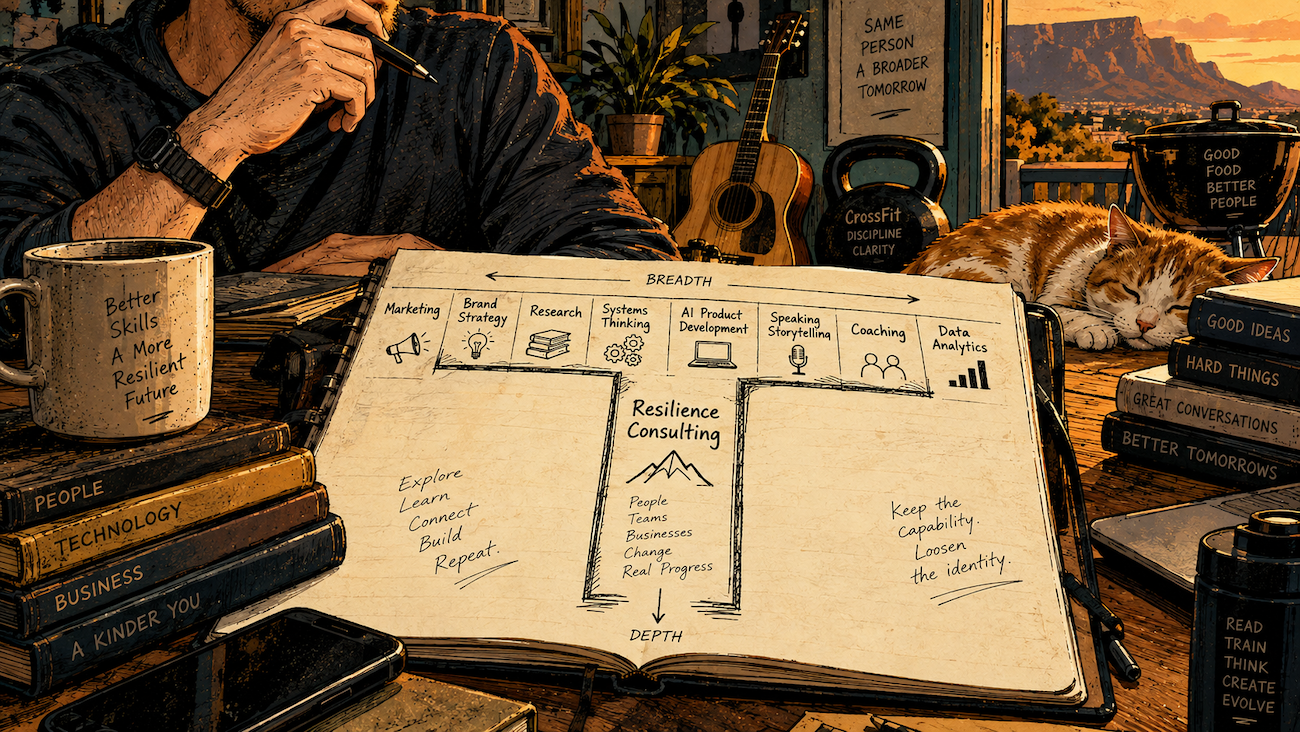
T-Shaped Skills: How to Build Career Resilience Before You Need It
Build career resilience with T-shaped skills: keep your deep expertise, broaden your capabilities, and learn how to explore and[…]
Employee Resilience: Why Purpose Matters to Business Resilience
How does employee resilience strengthen a business? Explore the role of purpose, alignment and individual capability under pressure.
2 Responses
[…] This is the part businesses often miss because they are too busy measuring outputs. Revenue, margin, conversion, productivity, engagement, retention and NPS all matter, but they usually show what has already happened. Strain tells you what the system is carrying to produce those outputs. It shows the load behind the number. […]
[…] of warning lights appearing on the dashboard. It echoed something I had written about previously in The D.O.S.E. Dashboard: the system can keep functioning long after the warning lights start flashing. I kept […]