Once I’m done with this blog, I will be about 3.5 minutes away from total depletion. That is why personal resilience is on my mind. Not the heroic, grit-your-teeth version that makes exhaustion sound like a branding opportunity. The practical version. The version that helps you read the numbers before the system starts making smoke.
For me, unless I can boil something down to maths and data, I struggle to stay interested in it for very long. Maths is one of life’s great joys if you are willing to nerd it up. There is a right answer and a wrong answer. There may sometimes be multiple correct answers, but understand the maths well enough and it becomes much harder to charge off confidently in the wrong direction like a LinkedIn thought leader on a rented bicycle screaming “alignment” into a hedge.
Once you understand the maths, you can throw statistics at it. You can build rigour into the direction you are moving in. You can stop relying entirely on vibes, instinct, and the sort of motivational quote that belongs on a gym wall next to a picture of a man shouting at a tyre as if the tyre has personally disappointed his ancestors.
That is why I’m interested in personal resilience. Too many people are being told to become tougher when what they actually need is a better way to read the equation.
A recent example to help drive this home.
My wife and I will, on the rare occasion, hit a domestic stalemate. This is the moment when we are both exhausted, both aware that something needs to be done, and neither particularly interested in being the noble idiot who does it. Dinner needs to be cooked. The dishwasher needs to be unpacked. The cats need something, which is normally either food, affection, or immediate access to a cupboard they will enter for four seconds before leaving in disgust. Some small but unavoidable domestic admin goblin has crawled out from under the furniture and demanded tribute.
When this happens, it comes down to a simple best-of-three rock, paper, scissors. A game, I will admit, in which I carry an unfair advantage over my wife.
After fourteen years together, I know she opens with rock. So I throw scissors and give her the first win. Confidence rises. She comes back aggressive with scissors. I play rock. Then she assumes I will not play rock again, so she repeats scissors. I repeat rock. This is not love. This is data with cutlery nearby.
It is a simplification, obviously. I am not claiming to be the Rain Man of domestic conflict resolution. But by understanding the variables – rock, paper, scissors – and the probabilities attached to my wife’s behaviour after fourteen years of data collection, I can somewhat game the system.
I missed the bigger application for years. I understood variables when they helped me win a stupid domestic game. I was much slower to admit the same logic applied to my own capacity.
The personal resilience equation
Personal resilience works in a similar way.
It feels emotional. It feels personal. It feels like something reserved for people who wake up at 4am, plunge themselves into ice baths, journal in leather-bound notebooks, and somehow have a resting heart rate lower than the operating temperature of a reasonably priced fridge.
But when you strip away the motivational fog, personal resilience becomes much more practical. It becomes a relationship between variables.
Valorie Burton is an author, speaker, coach and entrepreneur whose work sits in the field of personal development and applied positive psychology. She founded the Coaching and Positive Psychology Institute and holds a master’s degree in applied positive psychology from the University of Pennsylvania. Her work is powerful here because she does not treat resilience as heroic endurance. She breaks it into components that can be understood, strengthened and supported.
Her model of resilience can be understood as an equation:
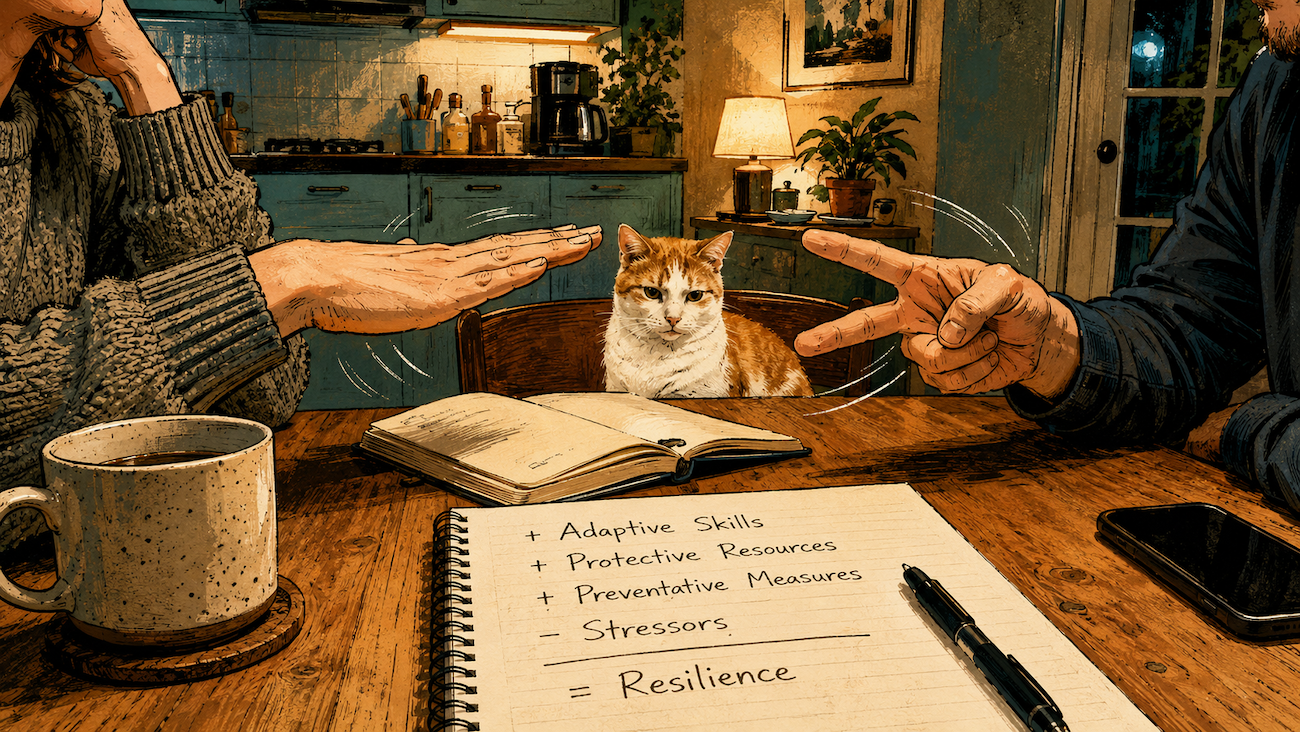
Available Resilience = Adaptive Skills + Protective Resources + Preventative Measures − Stressors
This moves personal resilience away from personality and into something we can actually work with.
Resilience is the maths of load versus capacity.
The personal resilience variables
For personal resilience, Burton’s variables are beautifully defined.
Adaptive Skills are how you think, react and behave in response to challenges and opportunities. They are the internal skills that shape your response under pressure. Responsibility. Personal ownership. Thought awareness. Locus of control. Flexibility. Self-coaching. Energy management. The ability to notice what is happening inside you without immediately handing the steering wheel to panic, defensiveness, avoidance or the part of your brain that wants to fake its own death and open a bait shop in Namibia.
Protective Resources are the resources you can draw on when pressure rises. Relationships. Wise counsel. Coaching. Professional connections. Financial resources. Employment options. Education. Training. Health. Access to useful information. They are the supports that make personal resilience easier before you are already face-down in the emotional gravel while life pokes you with a stick and asks whether you have tried being more positive.
Preventative Measures are the boundaries, routines, structures and choices that reduce unnecessary strain before it becomes a crisis. Saving money. Taking care of your health. Building skills before you urgently need them. Setting boundaries. Avoiding toxic relationships. Nurturing strong ones. Designing your life so that every challenge does not require a full emergency response from your nervous system, complete with flashing lights, sirens and a small man in a hi-vis vest shouting “THIS COULD HAVE BEEN AN EMAIL.”
Stressors are the pressures, demands, uncertainties, commitments and circumstances consuming your capacity. Some are unavoidable. Some are chosen. Some are inherited. Some are created by poor systems, bad assumptions, unclear expectations, ego, avoidance, or the deeply human tendency to say “yes” while every cell in your body is quietly building a canoe and planning to paddle away under cover of darkness.
Not all stressors arrive as tasks. Some arrive as old obligations, people-pleasing, fear of disappointing others, the need to prove yourself, or the nervous-system memory of what happened the last time you slowed down. If you only count the visible tasks, you miss half the load. You look at the calendar and wonder why you are exhausted, while ignoring the emotional admin quietly running in the background like malware with a Canva subscription.
When the numbers stop working
In personal resilience, if your stressors rise and nothing else changes, your available resilience drops. If your adaptive skills improve, your available resilience increases. If your protective resources are strong, pressure becomes easier to absorb. If your preventative measures are weak, life becomes a long sequence of fires you probably could have prevented, but now have to extinguish while wearing panic as a hat.
The point is not to turn your life into a spreadsheet, although I will not pretend that doesn’t sound mildly appealing. A clean dashboard. A few conditional formatting rules. Perhaps a tasteful little pivot table called “Reasons I Am Currently Making The Noise Of A Haunted Kettle.” The point is to stop treating depletion as a moral failure.
If personal resilience feels out of reach, read the equation. Stressors may be too high. Protective resources may be too thin. Preventative measures may be missing. Adaptive skills may be compensating for a life that has been badly designed, like putting a Ferrari engine into a shopping trolley and acting surprised when it becomes a flaming wheelbarrow of regret.
This is where “be more resilient” becomes lazy advice. In personal resilience terms, it asks the person carrying the load to toughen up without asking what created the load in the first place. It is the emotional equivalent of watching someone trapped under a piano and saying, “Have you considered improving your posture?”
By the time you are depleted, your options shrink. Your thinking narrows. Your patience evaporates. Your ability to make wise choices gets replaced by whatever decision gets you through the next ten minutes without making a noise that frightens the cats. Personal resilience is built earlier: in the thinking skills, relationships, boundaries, health, finances and support structures you develop before the crisis arrives and starts loudly rearranging the furniture.
So when I say I am 3.5 minutes away from depletion, I am not being dramatic. Well, not only dramatic.
I am looking at the equation.
Stressors are high. Adaptive skills are still online, but making the sort of noise a laptop makes when it has 47 Chrome tabs open, one of them is playing music you cannot find, and another has somehow opened a PDF from 2017 called Final_Final_v8_ACTUALFINAL.pdf. Protective resources exist, thankfully. Preventative measures are doing some work, although a few of them are currently being held together with caffeine, optimism and whatever emotional adhesive is available in the drawer.
The next time your personal resilience feels thin and you feel yourself running out of capacity, do not start with shame. Start with the equation. What has increased? What is missing? What was never built? What are you asking yourself to carry without support?
Personal resilience becomes practical when you stop pretending the numbers do not exist.
And right now, I can see the numbers. So I am choosing the most mathematically responsible thing available to me: disappearing into the bush, letting the noise drop, and giving the system a chance to recharge at every level.
Mental. Emotional. Physical. Spiritual.
Because awareness is not recovery. Awareness is the dashboard light. Personal resilience begins when you pull over before the engine exits the bonnet like a furious metal badger.
And I have seen enough.

The Resilience to Redefine Victory: Solveig Løvseth at IRONMAN Kona
Solveig Løvseth’s remarkable IRONMAN Kona finish reveals how resilience can mean changing course, recognising our limits and redefining victory.

Leadership Blind Spots: Would You Know If Pressure Changed the Way You Lead?
Leadership blind spots can grow under pressure. Learn how changing behaviour weakens feedback and leaves leaders unaware of their

Business Resilience: When People Stop Challenging How Work Gets Done
Business resilience can weaken while performance still looks fine. One early warning sign is when people stop challenging how[…]
One response
[…] demand a great deal from us. In Valorie Burton’s Rules of Resilience, resilience is framed as a balance: our adaptive skills, protective resources and preventative measures need to outweigh the stressors […]