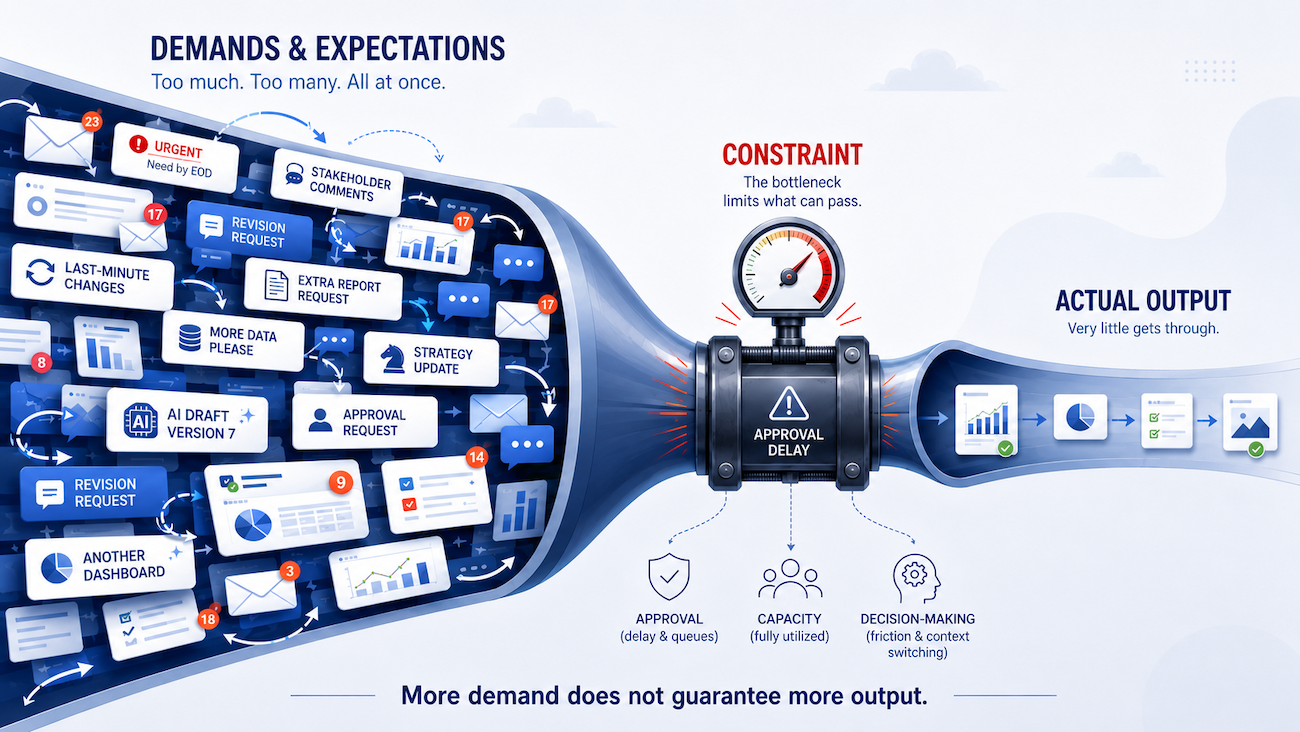
As part of the Gray Feather community, we have a book club every other month. Recently the book was Dan Heath’s Reset: How to Change What’s Not Working. While I still think Switch was a better read, there is useful thinking in Reset. One story around constraint keeps coming back to me because it captures the business capacity planning problem most organisations would rather avoid.
Imagine a donut shop. One person cooks the donuts in 60 seconds. Another person takes the orders in 90 seconds. A salesperson walks in with a special fryer that cuts cooking time in half. Fantastic. Except the shop still only serves one customer every 90 seconds, because the order taker is the actual constraint.
The fryer was never the problem.
The ordering process was. So now we have an expensive fryer sitting there like a chrome-plated monument to missing the point, while the order taker is buried beneath hostile donut people. The better move was to add another order taker.
Stop improving the wrong part of the system
I posted a version of this story on LinkedIn recently while thinking about AI, because it feels like the perfect explanation of what many businesses are doing right now. They are throwing AI at the visible parts of the system without first understanding where the real constraint sits. More output. Faster drafts. More dashboards. More automation. More turbo-fryers humming away while the queue quietly becomes a small civic uprising. That is not business capacity planning. That is tool adoption wearing a fake moustache and pretending to be strategy.
The issue is not that AI is useless. It is that AI does not automatically fix a badly designed system. If your approval process is broken, AI will help you create more work that still waits for approval. If your teams are misaligned, AI will help them produce more misaligned material faster. If your strategy is unclear, AI will help you generate more activity in service of the fog. Good business capacity planning asks where work is actually slowing down.
This is where businesses fall into what is called capacity fiction: building plans around desired work instead of actual capacity. The dangerous thing about capacity fiction is that it hides beneath normal performance. The deadlines are mostly hit. The campaign goes live. But underneath the visible output, the system is borrowing from quality, recovery, morale, creativity, attention and trust. In the short term, output appears stable, but the human system holding it together starts looking like duct tape, hope, and enough nervous energy to calm an entire herd of buffalo. Business capacity planning should expose that gap.
When the organisation becomes the constraint
This reminded me of a situation I dealt with several years ago. I was responsible for managing a global brand’s content and its presence out on the interwebs. It required coordinating with creative, paid media, social media, research, strategy and several teams with their own priorities. In theory, there was a plan. In reality, business capacity planning was being done by optimism, email chasing and hoping everyone would become available at precisely the same time.
In this case, diversity became the constraint. Anyone responsible for managing a brand will know the promise: “Yes, you get all the resource you need. Make us look exceptional. Unless there is another revenue-driving priority, in which case you get what is left at the bottom of the barrel after everyone else has finished licking it.” Teams were not lazy or careless. The constraint emerged because each team had its own siloed priorities, and those priorities determined where capacity went.
One recurring example was a global research report. On paper, it should have had focus because it carried weight, value and visibility. In reality, it depended on too many moving parts sitting in different priority queues. Research needed one thing. Creative needed another. Paid media needed something else. Strategy had its own pressures. Every part of the machine could justify why it was busy, but the work still needed to move through all of them. The project plan said the work was possible. The actual system was telling us it was not. That is the gap business capacity planning is supposed to expose.
Cross-functional work does not run on project plans alone. It runs on trust. Trust is operational infrastructure. Without it, every request needs extra explanation, every decision needs extra chasing, and every delay needs a small diplomatic mission involving calendars, Teams messages, and someone saying “just circling back”. When trust is thin, capacity gets eaten by coordination, and business capacity planning becomes theatre.
Why pressure is not capacity planning
When push came to shove and I had an executive leader breathing down my neck, the response of “there is just no capacity” was not accepted. On one occasion, the answer I got was: “Then be more unreasonable. That will get the work done.” I still cannot fathom how that narrative makes it to an executive level. Was there a cupboard marked “unreasonable” that contained three designers, a strategist, two media people and a calm account manager with a spreadsheet? If there was, nobody had given me the key.
At the time, I felt frustrated because part of me knew this was not the right route. But another part of me thought: if this is coming from an executive, maybe I should learn from that. With hindsight, I am glad I did not. “Be more unreasonable” is what leaders say when they have no diagnostic language for constraint. It sounds decisive, but all it really does is transfer the structural failure onto the person nearest the work.
The constraint does not disappear; it just gets renamed as someone else’s attitude problem.
This is where businesses become dangerous to themselves. They confuse pressure with capacity. They confuse urgency with alignment. They confuse “we need this” with “the system is able to produce this.” Needing a thing does not create the capacity to deliver it. Business capacity planning should prevent that confusion by forcing the uncomfortable conversation before the system starts compensating in hidden ways. A constraint ignored by leadership does not disappear. It moves into the people, becoming late-night work, thin patience, rushed thinking, weaker quality, strained relationships and compliance that looks like professionalism from a distance.
Burnout is system feedback
This is where business capacity planning needs to be matched with expected outputs. If a creative team, like the donut shop, can only produce X amount of work, but the request is for X plus Y, then of course it is not going to get done sustainably. It may get done once or twice. It may even get done for a while if the team is experienced, committed, over-caffeinated or still clinging to the belief that heroic effort will one day be recognised.
But over time, the system starts showing defects. Quality drops. Rework increases. People become harder to reach. Meetings become more tense. Creativity thins out. The people who care the most begin to carry the most, which is usually when the organisation starts calling it “high performance.” This is why business capacity planning cannot only count people, hours or budget. It also has to account for attention, recovery, decision speed, trust and the invisible work required to keep the machine moving.
I find Valorie Burton’s idea of Required Energy versus Available Energy useful in the resilience space. At an individual level, we can ask how much mental, emotional and physical energy is required, and how much is actually available. The same principle applies to business. Required Capacity is the work the business expects the system to produce. Available Capacity is the human, technical, financial, decision-making and recovery capacity available to produce that work sustainably. Better business capacity planning measures the gap between the two before the gap becomes strain.
When Required Capacity exceeds Available Capacity, the difference gets paid for somewhere: quality, wellbeing, innovation, trust, speed later, or attrition. Burnout is often the human system reporting a constraint the business refused to measure. If the same strain keeps appearing in the same places, across the same teams, around the same workflows, then the issue is probably not attitude. It is architecture, and business capacity planning needs to reveal it.
I used to see this in another organisation I worked with. Every quarter, teams would present their performance, and every quarter many of the same issues would come up. The question was almost always, “What are you going to do about it?” It was rarely, “Why does this keep happening, and how can we help resolve it?” That matters, because constraints are frequently not self-inflicted. They often come from upstream.
Averages hide the truth
One reason businesses miss constraints is that they hide in averages. The dashboard can look fine while one department, role level or workflow is carrying the performance fantasy like a donkey dragging a grand piano up Table Mountain. The average says we are okay. But underneath that, one team is drowning, one approval point is blocking flow, one manager is absorbing the shock, or one department has become where everyone else’s urgency mutates into resentment.
Averages are where constraints go to hide.
This is why business capacity planning needs to move below the average and into the hotspots. Where is work queuing? Where are decisions slowing down? Which team is constantly asked to absorb more? Where are deadlines being hit only because quality, recovery or trust is being quietly traded away? Those are not soft questions. Those are operating questions. Business capacity planning fails when it only looks at the average.
Cheap, fast, high quality: pick two
This is where the old project management triangle becomes useful. It has three corners: cheap, fast and high quality. The unfortunate reality is that you can only ever select two. If you want it cheap and fast, quality is unlikely. If you want it fast and high quality, it will probably not be cheap. If you want it cheap and high quality, you are going to have to wait. This is business capacity planning in its simplest form: every output has a cost, and pretending otherwise does not make the cost disappear.
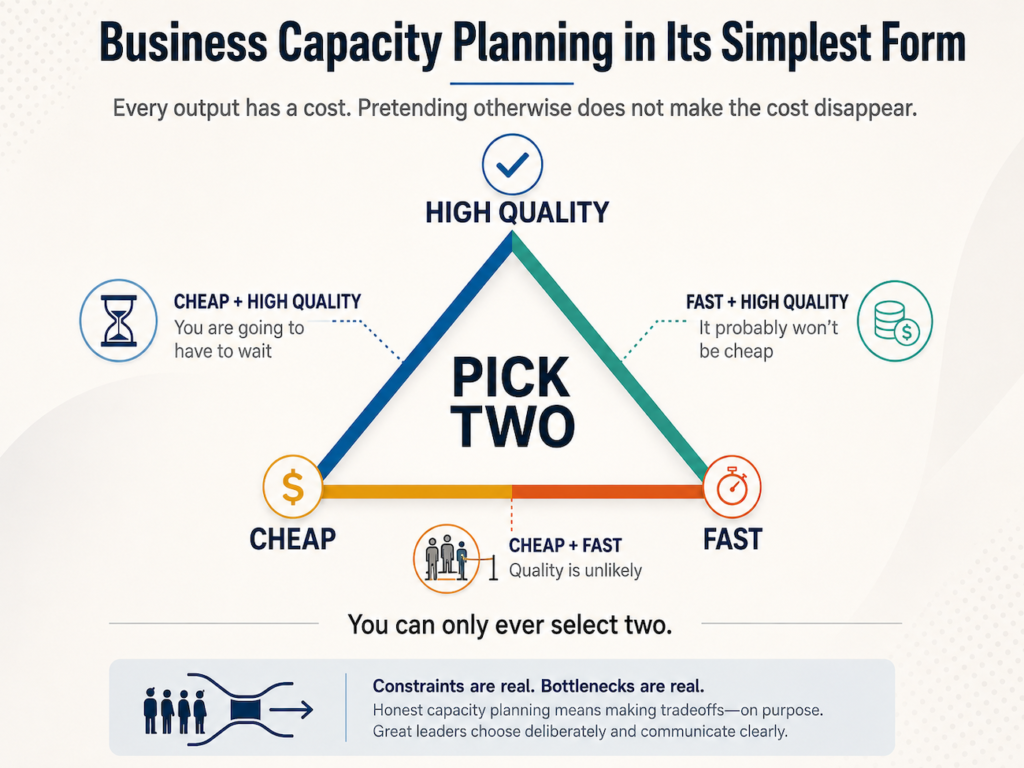
If leadership refuses to choose, the system chooses for them. It chooses lower quality, rushed thinking, hidden overtime, rework, resentment, and “fine” when everyone knows it is not fine. The triangle is not a project management cliché. It is a constraint diagnostic wearing a little corporate hat.
The real work is capacity honesty
The real work is not buying the faster fryer. The real work is business capacity planning that understands the queue. That means asking better questions before adding tools, pressure or heroic expectations. Where is work currently queuing? Which person, team, process or decision is everything waiting on? Where are we solving structural issues with personality pressure? Where are we adding technology without redesigning the workflow? What are we silently trading to hit the deadline: quality, recovery, creativity, trust or morale? That is business capacity planning with a pulse.
Most people want to do good work. So do not start with the assumption that people are not working. Start with the assumption that they probably are, and that the system may be asking them to produce more than the available capacity allows. That is why business capacity planning is not administrative housekeeping. It is resilience work. It is how you see strain before the system turns it into failure.
Constraints are measurable. Capacity is measurable. Strain is measurable. The only thing that is not measurable is the fantasy that if we apply enough pressure, the system will somehow become bigger than it is. It will not. It will compensate, degrade and eventually fail. The business may call it a people problem, but very often it started as something simpler.
The fryer was never the constraint, and everyone was too busy admiring the chrome to look at the queue. That is why business capacity planning matters.

The Resilience to Redefine Victory: Solveig Løvseth at IRONMAN Kona
Solveig Løvseth’s remarkable IRONMAN Kona finish reveals how resilience can mean changing course, recognising our limits and redefining victory.

Leadership Blind Spots: Would You Know If Pressure Changed the Way You Lead?
Leadership blind spots can grow under pressure. Learn how changing behaviour weakens feedback and leaves leaders unaware of their
Business Resilience: When People Stop Challenging How Work Gets Done
Business resilience can weaken while performance still looks fine. One early warning sign is when people stop challenging how[…]
3 Responses
[…] horizon is short enough and nobody asks where the cost went. Which is convenient, because asking where the cost went tends to ruin the mood in the same way a dead raccoon ruins a […]
[…] may be too high. Protective resources may be too thin. Preventative measures may be missing. Adaptive skills may be compensating for a life that has been badly designed, like putting a Ferrari engine into a […]
[…] Valorie Burton explores a useful relationship between Required Energy and Available Energy, something I’ve previously written about in Capacity Fiction: Business Capacity Planning Done Honestly. […]