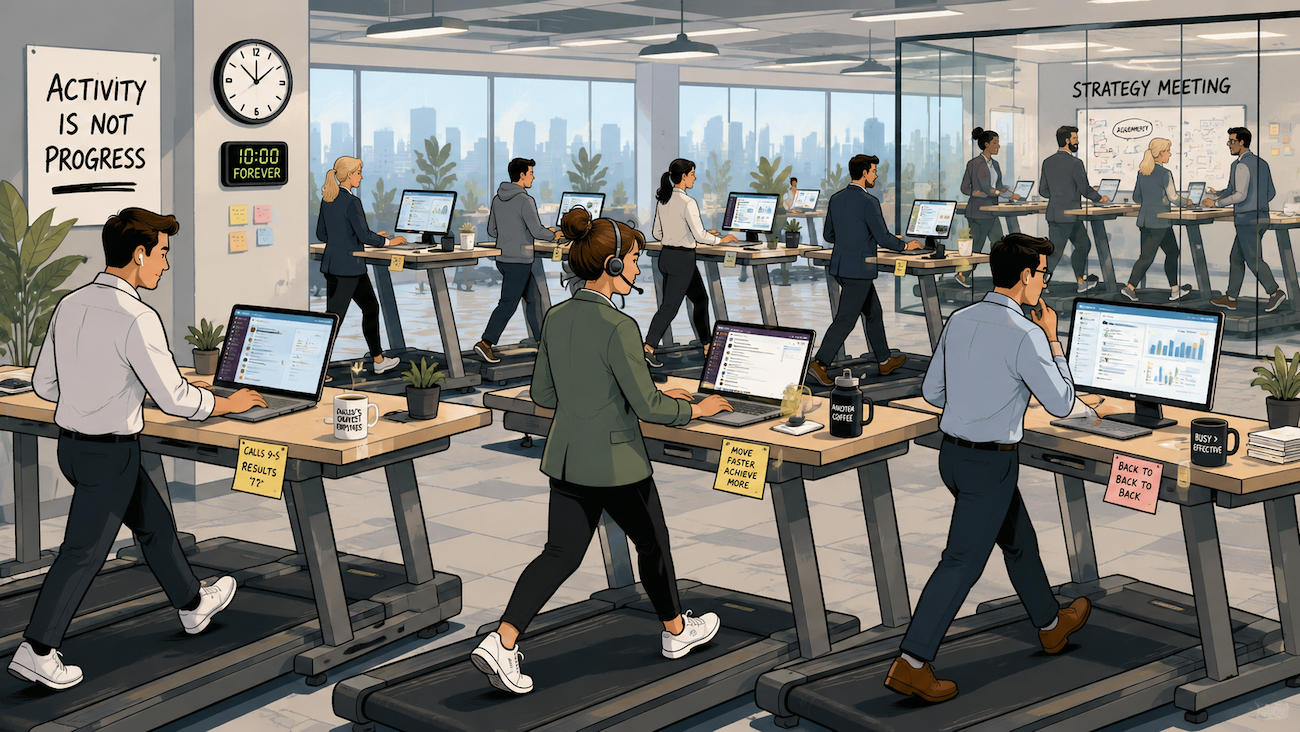
It’s 10am and you’re already moving into your second meeting with your second cup of coffee. Most mornings follow the same elegant choreography: caffeine, polite human interaction, calendar Tetris, repeat. If you’re lucky, you might find an hour before lunch to do something radical, like actual work.
There’s nothing inherently wrong with meetings, but we’ve quietly turned them into the corporate equivalent of jogging on the spot. Lots of movement. Impressive sweat. You’re still exactly where you started.
I’m fairly confident that individually we don’t have a productivity issue. But when we’re thrown into the system with everyone else there’s a design flaw that brings friction.
I remember a day not that long ago where I had six meetings before lunch. Not one of them was unnecessary on paper. Every meeting had a purpose, an agenda, and the right people in the room. By 1pm, I’d made coffee twice, spoken to half the business, and achieved absolutely nothing that resembled progress. And the worst part is that it felt like a productive morning.
I’ve also worked in a business that didn’t drive purpose. It drove results. Results without purpose motivate nobody but shareholders, and even then only until the next quarter rolls around like a slightly more aggressive sequel.
I remember sitting in meetings where multiple teams were all saying the right things, all hitting their numbers, and all doing exactly what they were supposed to do, yet nothing was moving forward. Because while everyone was aligned to their KPIs, they weren’t aligned to each other. One team’s success created another team’s problem, resulting in much talking and very little aligned momentum. This is how you end up with meeting overload, fragmented days, and the illusion of productivity.
What you’re experiencing isn’t random. It’s organisational systems design.
You don’t experience your organisation as “organisational systems design.” You experience it as your calendar, your inbox, your meetings, and that low-level hum of anxiety that suggests if you stop replying for 12 minutes, civilisation may collapse. But those things aren’t random. They are outputs.
They are the result of organisational systems design, whether intentional or accidental. If your days feel reactive, interrupted, and heavier than they should, that’s not because people suddenly forgot how to manage their time. It’s because the system design in your organisation rewards responsiveness over progress, visibility over value, and activity over outcome. Systems thinking in business makes this painfully obvious: behaviour follows structure, and if the structure is misaligned, the behaviour will be too.
Systems don’t care how hard you work. They care what they’re designed to produce.
In practice, organisational systems design shows up across three layers:
- The business as a whole (strategy, direction, big decisions)
- The departments (how work is organised and measured)
- The teams (where pressure is actually felt and absorbed)
Most organisations optimise all three layers of their business system structure without ever checking if they’re aligned. Which brings us to the real question: what is this organisational system actually optimised for? If that answer isn’t clear, everything else starts to drift.
Purpose isn’t a poster on the wall or a line in an annual report that sounds like it was written by a committee of well-meaning robots. It’s the mechanism that drives organisational systems alignment. When purpose is weak or unclear, organisational systems design doesn’t just become inefficient, it becomes confused. People stop making decisions based on what actually matters and start making them based on what’s visible, urgent, or politically safe. Metrics take over, activity replaces progress, and collaboration overload creeps in as effort increases without output.
I wrote about this previously using LEGO as an example of what happens when misaligned KPIs in organisations override business purpose. When organisational systems alignment is strong, decisions become simpler and behaviour becomes coherent. When it’s not, the system starts optimising for the wrong things, and you feel it everywhere.
Most organisational systems design isn’t broken. It’s working exactly as designed, and what it’s producing is what you’re experiencing.
What makes this more interesting, and slightly more uncomfortable, is that outcomes don’t come from instructions alone. They emerge. No one sets out to create meeting overload productivity traps or fragmented workdays, but when incentives, structures, and behaviours interact, that’s exactly what you get. If you want to go deeper on that idea, I unpack it further here: Emergence in Business – Designing Systems That Grow
As Joi Ito and Jeff Howe highlight in Whiplash: How to Survive Our Faster Future, organisations default toward order and control. In trying to make things efficient, they often build rigid organisational systems design that reduces adaptability. The system becomes efficient on paper, but fragile in reality.
How poor organisational systems design drains resilience
Organisational systems design doesn’t usually fail dramatically. It degrades, slipping into what you might call “limp mode,” where everything still works on the surface – meetings happen, emails get answered, deadlines are met – but it’s slower, heavier, and requires far more effort than it should. Capacity drops, frustration rises, and people start to feel like they’re working twice as hard for half the output, like trying to run Windows 95 on a toaster.
The problem isn’t always the people. It’s the organisational systems design asking them to operate in ways that aren’t sustainable. This is where organisations get caught out, because this is where it stops being a system problem and starts becoming a human one.
When organisational systems design runs like this for long enough, people don’t just get busy, they start to disconnect. Work that once felt meaningful starts to feel mechanical, energy drops while expectations remain high, and you find yourself working harder while caring less. Over time, you don’t just lose efficiency; you lose engagement, clarity, and the version of yourself that used to enjoy the work. This doesn’t happen because people suddenly change, but because the organisational systems design around them does.
This is where organisational resilience systems become critical. When one part of the system is under strain and nothing is addressed, the system compensates. Other teams pick up the slack, high performers absorb more work, and meetings increase to maintain alignment. Slowly, almost invisibly, the entire system becomes heavier and less efficient. You don’t notice it immediately; you just feel like things are harder than they used to be.
That’s not a motivation problem. That’s system strain.
What makes this particularly dangerous is that most organisations are very good at measuring performance but very poor at understanding the pressure required to sustain it. Business systems track revenue, output, and utilisation relentlessly, but rarely track the strain underneath them. The result is that organisational systems design can look healthy on paper while quietly exhausting the people inside it.
The most effective organisations understand that organisational resilience systems are not an add-on. They are part of organisational systems design itself. They don’t just focus on what the system produces; they focus on how the system holds up while producing it. Because at the end of the day, organisations are still human systems, reliant on people to think, decide, collaborate, and act. If the organisational systems design those people operate in is under pressure, everything else eventually follows.
We’re generally quite good at maintaining ourselves physically. If something starts to hurt, we pay attention, get it checked, and fix it before it gets worse. We need to start applying the same thinking to organisational systems design, because the next time your day feels fragmented, reactive, and heavier than it should, the question isn’t how you manage your time better. It’s what the system has been designed to produce.
Because the system will not fix itself, and if you don’t question organisational systems design, you don’t fix the problem – you just get better at surviving it. Over time, that’s exactly how resilient people burn out.

The Resilience to Redefine Victory: Solveig Løvseth at IRONMAN Kona
Solveig Løvseth’s remarkable IRONMAN Kona finish reveals how resilience can mean changing course, recognising our limits and redefining victory.
Leadership Blind Spots: Would You Know If Pressure Changed the Way You Lead?
Leadership blind spots can grow under pressure. Learn how changing behaviour weakens feedback and leaves leaders unaware of their
Business Resilience: When People Stop Challenging How Work Gets Done
Business resilience can weaken while performance still looks fine. One early warning sign is when people stop challenging how[…]
No responses yet