
Systems thinking in business has changed the way I understand purpose. I will frequently attract at least one confused, tilted head when I start asking questions about it, whether I’m talking about an individual or a business.
I have always believed purpose gives us direction. For a business, it gives people something larger to work towards than the fairly uninspiring objective of “make the shareholders more money.” For an individual, it gives some direction to the choices we make about where we spend our time and energy.
I’ve written about this before, both in terms of purpose and employee resilience and what happens when a business becomes more interested in individual targets than the thing everybody is supposed to be building together. I still believe all of that. I’ve just realised I was probably only understanding half of why purpose matters.
Learning to think in systems
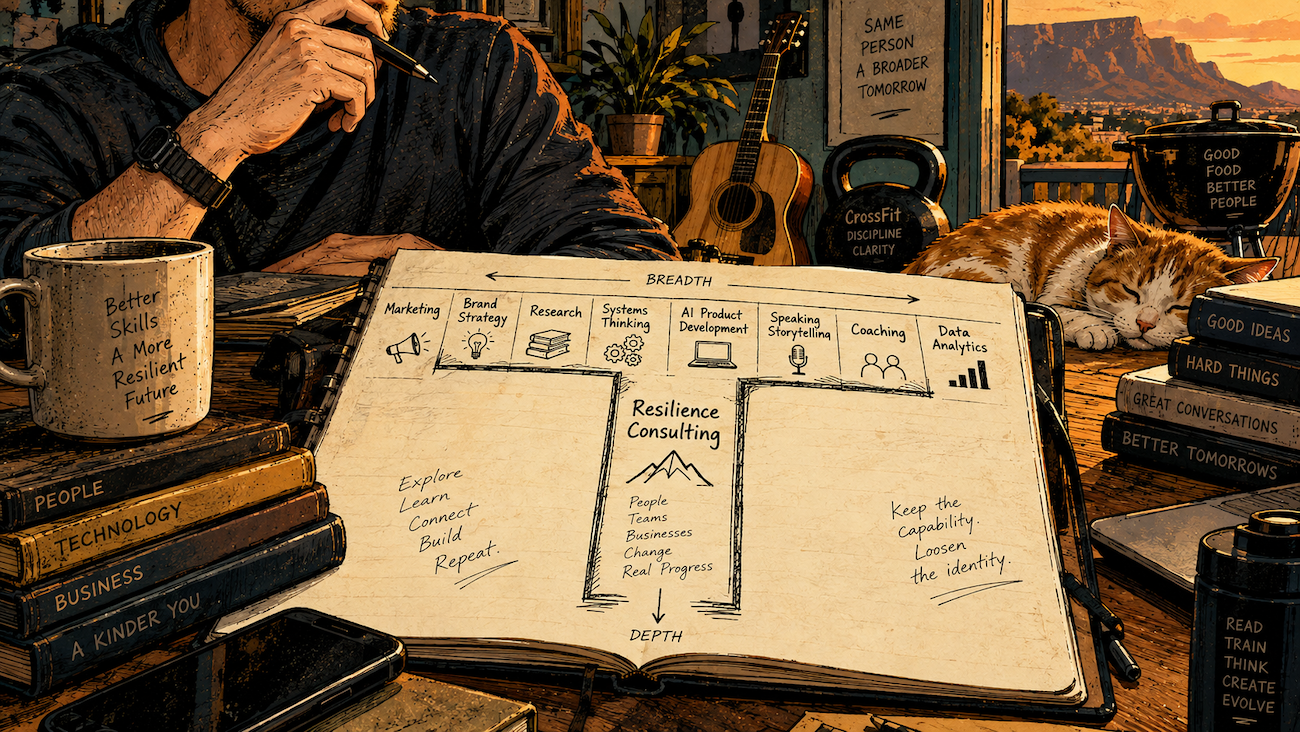
One of the T-shaped skills I’m actively developing is systems thinking.
My ADD brain has never been particularly interested in travelling neatly from A to B via the road provided. It tends to ricochet between ideas, spot relationships, disappear down a side road, come back carrying three unrelated facts and insist that somehow they are all connected. Quite often, annoyingly, they are.
That instinct is one of the reasons I’ve always been more comfortable operating as a generalist than a narrow specialist, but instinct and capability are not the same thing. I’ve been deliberately trying to get better at the latter.
Having read Think in Systems by Zoe McKey, something clicked about purpose that I hadn’t properly understood before. Purpose doesn’t simply sit above a business and give the people inside it something nice to believe in. It forms part of the system itself.
What actually is a system?
McKey, drawing on Donella Meadows, describes a system as related components working together within an environment to achieve an objective. That becomes much easier to work with when the system is broken into three parts: elements, interconnections, and function or purpose.
The elements are the actors within the system. They can be physical and obvious, but they don’t have to be. In a business, people, technology, resources, structures, knowledge and capability can all form part of what makes the system what it is.
The interconnections are how those elements influence one another. Some are easy to see: reporting lines, meetings, processes or the movement of a product through a business. Others are less visible: information, incentives, rules, feedback and the signals that tell people how things actually get done around here.
Then there is what all of it is there to do. For nonhuman systems, McKey uses function. For human systems, purpose.
Her scrambled-eggs example makes this considerably less academic. Eggs, salt, oil, heat and a frying pan are elements in a system. They interact in a particular way and, provided I don’t become distracted halfway through and wander off to answer an email, the output is breakfast.
Scrambled eggs don’t need to stare wistfully out of the kitchen window wondering whether they are living a life of meaning, whether they’ve made the right career choices or whether hollandaise might have been their true calling. Their function is enough.
A business is a human system, which makes that final component considerably more interesting.
Purpose changes more than I realised
I previously thought about purpose largely as a way of aligning people. That thinking led to an earlier article where I used LEGO to explore what happens when KPIs start replacing business purpose.
Give five people separate pieces to build, separate targets to hit and no shared understanding of the finished object, and individual efficiency does not guarantee a useful result when you put everything together. You may simply end up with five beautifully optimised bits of nonsense and somebody in Finance congratulating everyone on the quarter.
Systems thinking takes the purpose argument somewhere else.
Consider what happens when we change the different parts of a system. Replace the students in a classroom and the classroom remains recognisably a classroom; you have changed its elements. Keep the students but change the relationships between them and the teacher, and the classroom starts operating differently; you have changed its interconnections.
Now keep the same people and relationships but change what the classroom exists to achieve. If its purpose shifts from helping students learn to actively preventing them from learning, the desks, whiteboard and faint smell of permanent marker might all remain, but you no longer have the same system in any meaningful sense.
That was the piece I had been missing about purpose. It isn’t simply the inspiring bit we add once the serious work of structure, targets and operations has been completed. It helps determine what all of those things are ultimately organised towards.
Purpose can change, of course. Suggesting otherwise would be an impressively rigid position for somebody who has built a company called Antistable. But changing purpose is different from replacing a person, introducing some software or redesigning a process, because you have changed what the system itself is trying to achieve.
What if the wall is lying?
There is another idea in Think in Systems that makes this far more useful in a business context: purpose is not always obvious, but we can often learn what it is by watching what a system actually does.
That gives purpose statements a fairly unpleasant test.
Imagine a business with “We put our customers first” written prominently across its website and office walls. At the same time, its incentives overwhelmingly reward short-term sales, its processes prioritise internal efficiency, and employees who spend extra time resolving difficult customer problems are penalised for missing productivity measures.
I’m not arguing that this proves the business doesn’t care about customers. I am asking what somebody who had never seen the words on the wall would conclude after watching how the system behaves.
When money, incentives, decisions and behaviour consistently point in one direction while the purpose statement points in another, the vinyl lettering does not get the deciding vote.
Pressure makes the question even more useful. If budgets tighten or targets are missed, watch what gets protected, what gets sacrificed, where money continues to flow and which behaviours still get rewarded. The poster tells us what the business would like to believe about itself; its repeated behaviour gives us another source of evidence.
Ideally, those two things know each other.
Stop starting with the person
This has also changed how I think about problems inside organisations. When something goes wrong, our instinct is often to find the broken bit: which team missed the target, which process failed, which person needs to perform better.
Sometimes that is exactly where the problem sits. Sometimes Dave really did cock it up, and no amount of systems thinking is going to turn Dave accidentally emailing the entire company into an elegant lesson on organisational design.
But stopping with Dave can also be wonderfully convenient.
Systems thinking asks what produced the outcome in the first place. What are we actually trying to achieve? What people, capabilities, technologies, resources and structures make up the system? How do information, decisions, incentives, processes and relationships move between them? And what does that combination keep producing?
If the same problem keeps appearing, it becomes worth asking whether the system is malfunctioning at all. It may be producing exactly what it has been set up to produce.
Changing an individual element may solve an immediate problem, and changing an interconnection may alter how the system behaves. But if the purpose guiding all of it is confused, contradictory or no longer useful, we can end up optimising everything underneath it while becoming more efficient at travelling in the wrong direction.
There are few things quite as corporate as proudly announcing that we have achieved 14% more speed while heading towards the wrong airport.
I wasn’t wrong about purpose. I was incomplete.
I still believe what I believed when I first started irritating people by asking them about purpose. It gives people direction, helps us understand why our work matters and gives individual goals somewhere useful to point.
What systems thinking has changed is the scale at which I now see it. Purpose does not only give direction to the people inside an organisation; it gives direction to the system they operate within.
People will change. Technology will change. Structures will change. Markets will move. The environment around the business will keep shifting whether we particularly enjoy that fact or not, and the system will have to adapt with it.
Purpose helps us know what all of that adaptation is for.
That makes it considerably more useful than another afternoon spent arguing over whether the company exists to “unlock human potential”, “shape a brighter future” or whatever phrase survived the final round of Post-it notes.
So the next time I receive the slightly concerned tilted head after asking someone about purpose, I now have an even more irritatingly long answer available.
Your business already has a purpose, and the system around it will tell you a great deal about what that purpose really is. The useful question is whether it is the same one you put on the wall.
T-Shaped Skills: How to Build Career Resilience Before You Need It
Build career resilience with T-shaped skills: keep your deep expertise, broaden your capabilities, and learn how to explore and[…]
Employee Resilience: Why Purpose Matters to Business Resilience
How does employee resilience strengthen a business? Explore the role of purpose, alignment and individual capability under pressure.

Authenticity and Consistency: “Stop Trying to Be Someone”
Authenticity and consistency are closely linked. Learn how natural alignment can make long-term consistency easier and more sustainable.
No responses yet