
I’ve started writing this blog about half a dozen times. Not because I don’t know what I want to say, but because I’m currently up to my eyeballs in painkillers. I had shoulder surgery four days ago (at the time of writing), and stringing together coherent thoughts has become an ambitious undertaking. Naturally, I’m also writing a talk for the Digital Marketing Conference, so I should probably start apologising to that audience now.
A few weeks ago, my friend Bruce Burgess introduced me to an idea that challenges how we run businesses: the strategies responsible for our success may be the very things making us vulnerable to what comes next. It came up in a conversation that started much more casually.
A couple of times a year, I organise a lads’ lunch. It’s a chance to assemble mates who, thanks to work, children and the general inconvenience of adulthood, have become remarkably difficult to get into the same room. Bruce and I hadn’t caught up in over a year, so we worked through family, his move to a quieter part of the Western Cape, and my two years of studying, researching, speaking and building a business around resilience.
Rather than regret asking, Bruce introduced me to the Era of Standard Deviation. After years exploring uncertainty and organisational resilience, I hadn’t encountered the term before. It was a far more elegant explanation of something I’d been trying to articulate: what happens when the conditions that made us successful are no longer the conditions we’re operating in?
The Average Pilot Who Didn’t Exist
I have a rather unhealthy enthusiasm for statistics. There’s something satisfying about finding patterns in enormous amounts of information, even if my enthusiasm isn’t widely shared at dinner parties.
Standard deviation measures how widely values are spread around their mean, or average. Lower deviation means they’re clustered more closely; higher deviation means they’re more dispersed. Averages help us forecast demand, understand customers and measure productivity, but they can conceal important differences.
One of my favourite examples comes from the United States Air Force. In the 1950s, researcher Gilbert Daniels examined measurements from 4,063 pilots across ten physical dimensions, looking for those who fell within the designated average range – the middle 30% – on all ten. The findings are described in The Flaw of Averages.
The answer was zero. Not one pilot fitted the defined average range across every dimension, despite all the effort spent establishing the average pilot’s measurements. Somewhere, an engineer had effectively designed a cockpit for a gentleman who could only be assembled from the spare parts of several different people.
The Air Force moved towards adjustable cockpits that accommodated a wider range of human dimensions. Rather than force pilots to fit the system, the system could accommodate variation.
Businesses make similar mistakes. An organisation can report healthy average engagement while one department falls apart; two teams can deliver identical results while one operates comfortably and the other survives on overtime, caffeine and the increasingly desperate belief that things will calm down next month. The average tells us about performance, not necessarily what that performance costs.
Welcome to the Era of Standard Deviation
French biologist Olivier Hamant has popularised the idea that we’re moving from an era dominated by the mean towards one in which fluctuations and variability matter more. He argues that ecological pressures and environmental instability are challenging the dependable conditions around which we’ve designed many systems.
I’ve spent years discussing VUCA – volatility, uncertainty, complexity and ambiguity. Hamant offers a useful way of seeing why those conditions matter to businesses.
Imagine a business receiving an average of 1,000 orders a day. Historically, demand fluctuates between 900 and 1,100, and the company builds an efficient operation around that predictable range.
Now imagine the average remains 1,000, but daily orders swing between 400 and 1,600. Management opens its monthly report and sees that average demand hasn’t moved an inch, while the warehouse spends half the month resembling an abandoned shopping centre and the other half the evacuation of a small country.
Deliveries are late, overtime is soaring, customers are furious and the operations manager has begun communicating exclusively through clenched teeth. The average looks perfectly healthy while the operation is anything but.
It’s hypothetical, but important: even when the average remains unchanged, greater variation can transform what a system needs to handle. The monthly average alone wouldn’t reveal the operational risk.
We’ve become exceptionally good at optimisation, stripping out inefficiencies and building operations that perform beautifully under expected conditions. Hamant argues for greater emphasis on robustness. In biology, redundancy, cooperation and alternative ways of functioning can help systems survive when conditions change.
Some of the spare capacity we’ve learned to eliminate may be precisely what helps an organisation absorb disruption. Maximum performance under expected conditions and continued capability under unexpected ones are not the same thing.
We’ve Become Exceptionally Good at Yesterday
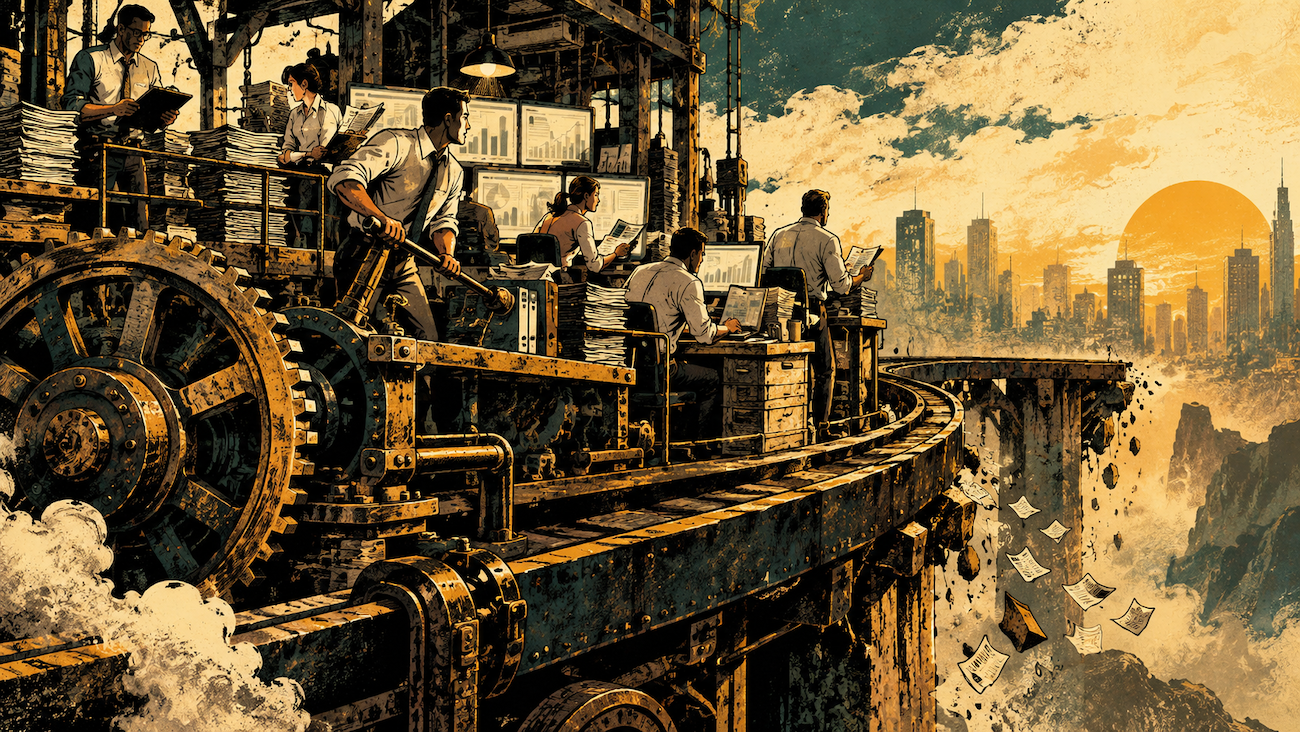
Imagine spending twenty years building a successful business. You’ve developed strategies, assembled teams, made difficult decisions and earned recognition, only to have someone suggest that the very approaches responsible for your success may now make the organisation vulnerable.
That’s frightening because it challenges your judgement and professional identity, not merely a plan. Marshall Goldsmith captured the problem in What Got You Here Won’t Get You There: we repeat what works, while organisations reinforce it through their structures and incentives.
The strategies that made us successful aren’t necessarily wrong. The conditions that made them successful may no longer exist. That possibility is uncomfortable precisely because both statements can be true.
A business might claim to value adaptability, yet reward only this month’s targets and cancel experiments that don’t immediately improve the financial report. People respond to what the system rewards, not simply what leadership says it values.
Winning This Year. Losing the Next Five.
One of my biggest frustrations with business is how good we’ve become at optimising short-term output, sometimes at the expense of the ability to sustain it. The financial results can look impressive while the organisation’s underlying capacity deteriorates.
Imagine a company nearing year-end with revenue below expectations and costs climbing. Leadership proposes cutting the workforce by 20%; employment costs fall, margins improve and the spreadsheet looks considerably happier. But has the business eliminated 20% of the work?
If the workload stays largely unchanged, the remaining employees absorb it. They work longer hours, take on new responsibilities and compensate for missing capacity. Projects still get delivered, customers remain satisfied and leadership might even announce that the restructuring was a tremendous success.
Except extraordinary effort has become the expected standard. The business appears more efficient while the people running it quietly exhaust the very capacity on which it depends. When the next disruption arrives, there may be little left to draw upon.
An organisation can mistake its people’s extraordinary effort for evidence that its systems are performing well. Today’s output tells us what the business achieved; it doesn’t necessarily tell us whether it can achieve it again tomorrow.
I’ve experienced how an organisation can continue delivering while the people doing the work gradually lose confidence in its direction. I explored that experience in Employee Disengagement: When Good Teams Stop Believing.
Sometimes reductions are necessary, and better systems genuinely enable smaller teams to accomplish more. But we should examine what we’re sacrificing with the same enthusiasm we apply to what we’re saving: what does this decision improve over twelve months, and what might it make harder over the following three years? Workload, turnover, critical skills and capacity to meet new demand belong alongside the cost savings.
Then there are the incentives. Shareholders want returns; executives have bonuses and finite tenures. Someone might spend five years improving reported performance, collect substantial rewards and depart before the consequences emerge, leaving a package addressed to ‘Whoever Has the Misfortune of Being Here Next’.
James P. Carse’s distinction between finite and infinite games, later brought into business thinking by Simon Sinek, offers another perspective. Finite games are played to win; infinite games are played to keep playing. Yet we often run businesses as though the final whistle blows at the next reporting period.
Continuing to play requires people, knowledge, trust, adaptability and the willingness to contribute, not merely this year’s profits. Sometimes sustaining those resources means accepting short-term financial pain instead of handing the next leadership team a beautifully formatted disaster.
Keep the Destination. Revisit the Route.
I’ve become sceptical of five- or ten-year strategies treated as fixed routes regardless of what changes around them. Having a long-term ambition is valuable, but an ambition and a detailed plan aren’t the same thing.
A company might aim to double its size over a decade, then build an elaborate plan on assumptions about markets, customers and technology. Five years is an extraordinarily long time to assume the world will continue cooperating with a PowerPoint presentation.
In Whiplash, Joi Ito and Jeff Howe contrast compasses with maps. A map assumes we know the terrain; a compass helps us retain direction when the terrain changes. Rolling strategies apply that logic by revisiting assumptions as new information emerges, rather than measuring progress only against the original plan.
Dan Heath’s Reset also argues for examining how work actually happens rather than trusting management assumptions. Before another round of optimisation, leaders should understand where the real constraints sit.
I’d like leadership teams to examine three things more deliberately. Look beyond the average: where do teams or operations experience very different outcomes, and what explains them? Measure what you’re sacrificing: what future capability disappears when we improve today’s results? Keep the destination, revisit the route: which assumptions behind our plan would we no longer confidently make today?
This isn’t an invitation to change direction whenever something unexpected happens. That would be exhausting, expensive and leave employees wondering whether management had replaced strategic planning with a Magic 8 Ball. Robust systems absorb ordinary fluctuations; they don’t require everyone to reorganise the business every Tuesday.
Sometimes the right decision is to change the plan. Sometimes it’s to resist optimising away something that’s keeping the organisation capable.
The Future Doesn’t Owe Us Predictability
Bruce gave me a clearer way of explaining why resilience matters. We’ve built extraordinary businesses using averages, historical patterns and strategies that worked under the conditions in which they developed, but the world doesn’t owe us those conditions.
Sustained success means knowing what our systems can withstand and what we’re sacrificing to deliver today’s results. The Air Force eventually stopped designing cockpits around an average pilot who didn’t exist; perhaps it’s time we stopped designing businesses around an average future that might never arrive.

The Resilience to Redefine Victory: Solveig Løvseth at IRONMAN Kona
Solveig Løvseth’s remarkable IRONMAN Kona finish reveals how resilience can mean changing course, recognising our limits and redefining victory.

Leadership Blind Spots: Would You Know If Pressure Changed the Way You Lead?
Leadership blind spots can grow under pressure. Learn how changing behaviour weakens feedback and leaves leaders unaware of their
Business Resilience: When People Stop Challenging How Work Gets Done
Business resilience can weaken while performance still looks fine. One early warning sign is when people stop challenging how[…]
No responses yet