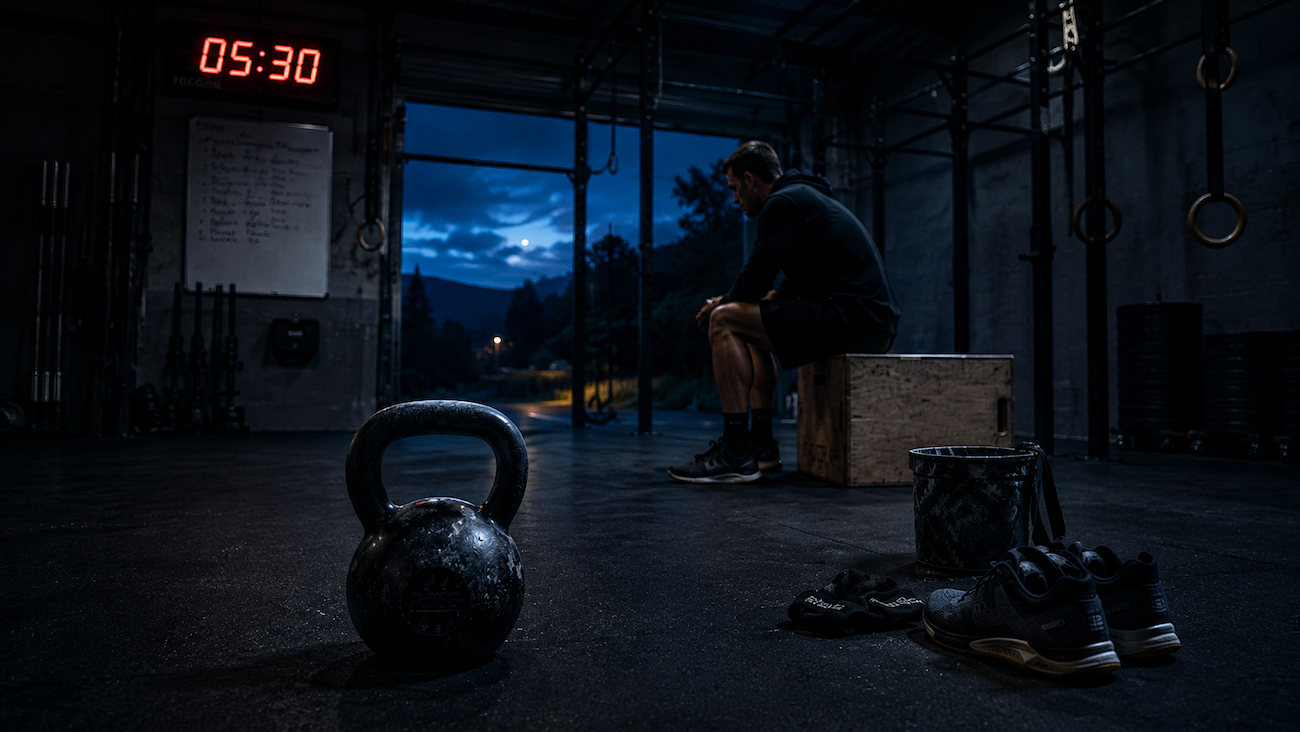
I haven’t been to my usual CrossFit training for over two weeks now. For anyone remotely normal, this probably doesn’t sound particularly dramatic. People skip the gym. It happens. But for almost ten years my weekday mornings have started at 04h45 – and no, that is not a typo – so that I can be at training when the session starts at 05h30.
Doing this in the middle of a Cape Town winter requires a fairly particular way of organising your life. You need to be in bed early enough that you have a fighting chance of being asleep by 21h00, often with the assistance of an oh-so-valuable premium Headspace subscription gently encouraging your brain to shut up while somebody plays the soothing sound of a river. All very tranquil until the alarm goes off at a time normally reserved for international airports, dairy farmers and particularly bad decisions.
But I’ve done it for nearly ten years. CrossFit has become part of the architecture of my life. It structures my mornings, forces better sleep, gives my ADD brain somewhere useful to put a considerable amount of surplus energy and gives me some mandatory social time, which matters more than I probably give it credit for. I’m an extrovert who works from home, so training is one of the few parts of my week where being around other people happens automatically. Somewhere along the way, all of that also became part of how I think about myself. And, while I’m figuring out alternatives for the training itself, that social part is one piece of the new system I haven’t quite worked out how to replace yet.
I am someone who trains.
Which is why deliberately stopping has felt rather uncomfortable. This isn’t really a story about CrossFit as much as it is about the irritating moment when the advice you would confidently give somebody else becomes the advice you have to take yourself.
On the whiteboard in my office are various scribbles I’ve accumulated over the years. Ideas, reminders and sentences that have been useful when things get difficult. One of them comes from Jordan Peterson’s 12 Rules for Life: treat yourself like someone you are responsible for helping. It is an incredibly simple idea that becomes substantially harder when the person you are responsible for helping happens to be you.
Because if a friend came to me and said, “Look, I’m building a business platform that is taking up a huge amount of time. I’ve started building AI products for clients. I’m developing workshops. I’m trying to build a speaking career and have a major conference talk coming up. I still want to practise guitar for an hour every day, exercise for an hour and a half, spend proper time with my wife, and there is quite a bit happening personally as well…” I suspect my first question would be: “How long exactly were you planning on doing all of this before something fell off?”
The problem is that I am, historically, a creature of extremes. When I work, I work. When I train, I train. When I decide to practise guitar every day, it somehow becomes a constitutional requirement. Moderation has never been my natural habitat. Left entirely to my own devices I seem to oscillate between excessive discipline and sitting up until one in the morning drinking whisky while watching increasingly obscure live concerts on YouTube. Both are enjoyable; only one is especially helpful the next morning.
When rest does not mean switching off
I had recognised that I needed a break recently and we disappeared into the bush for a few days. The holiday itself required some redesign when our original plans went sideways, something I wrote about in How to Adapt When Plans Change. We eventually changed what success looked like, slowed everything down and had a genuinely good trip. There was, however, one fairly important flaw in my recovery strategy.
Before leaving, I had been waiting to hear whether I had been selected for a speaking engagement in Johannesburg. It was a big deal for me. I’m approaching a year since starting the Story-to-Stage programme, and speaking has gone from something I vaguely wanted to do to something I am deliberately trying to build into a meaningful part of my career. I had been told I would hear before we left, but I didn’t.
So instead of switching my phone off for the week, which is what I would normally try to do, I periodically turned it back on to check my email. Again. And again. Apparently adapting to an angle grinder in the African bush was easier than adapting to one unanswered email.
The email never arrived, but I did successfully ensure that some part of my brain remained connected to work for most of the trip. We got away physically; I’m less convinced the engine ever really switched off. Then we came home and everything started again.
The signs that something needed changing had actually been hanging around for a while. Over the previous two or three months, 04h45 had become progressively harder to action. There wasn’t one terrible morning or dramatic collapse. The alarm would go off and the negotiation required to get out of bed was simply becoming slightly more difficult than it had been the week before, which was unusual for me.
Energy was flat. The endorphin hit I usually get after training had become increasingly thin, if it arrived at all. I had been powering through several injuries, one of which has subsequently graduated from “annoying shoulder” to “shoulder that now requires a major operation”. And I was still trying to train at roughly the level I had built myself up to ahead of competing in the Deadly Dozen fitness event earlier this year.
None of these things, individually, felt catastrophic, and that may actually be part of the problem. There was no cinematic moment in which I fell to my knees while Hans Zimmer played ominously in the background. There were just more demands, slightly less energy, more things requiring attention and a growing number of warning lights appearing on the dashboard. It echoed something I had written about previously in The D.O.S.E. Dashboard: the system can keep functioning long after the warning lights start flashing. I kept driving.
James Clear writes in Atomic Habits:
“You do not rise to the level of your goals. You fall to the level of your systems.”
I have spent years thinking about systems in organisations and increasingly about resilience as a system too. Yet somewhere along the line I had made the fairly obvious mistake of assuming that because one part of my system had worked brilliantly for almost ten years, it therefore needed to keep operating in exactly the same way. CrossFit hadn’t suddenly become the problem; the circumstances around it had changed, and so had the demands on exercise recovery.
There is also an identity trap hidden inside that. Once something has formed part of your life for long enough, changing it can start to feel like changing who you are. “I train at 05h30” had moved from something I did into part of the evidence I used to describe myself.
There is probably some ego wrapped up in that too. Ten years of showing up at 05h30 gives you a wonderfully convenient story about yourself: disciplined, committed, capable of doing hard things. When things get difficult, you push through them. The uncomfortable realisation has been that doing the hard thing and doing the sensible thing are not always the same thing.
Stopping therefore felt suspiciously like going backwards, even though resilience, at least as I have increasingly come to understand it, cannot simply mean proving that you can continue carrying more. At some point it also requires recognising what can be put down.
Dan Heath captures the principle rather neatly in Reset:
“Change is not AND, it’s INSTEAD OF.”
That one has been rattling around my head a lot lately because my default operating model has usually been AND. Build Antistable Systems and build the AI work and build the speaking career and create workshops and train hard and practise guitar and maintain relationships and deal with everything else life happens to send down the conveyor belt. Eventually there needs to be an INSTEAD OF somewhere.
There is an obvious challenge to my own logic here: I have rather conveniently decided that the work stays and CrossFit is the thing that moves. That is a choice rather than some objective hierarchy handed down from above. But priorities are choices, and I’m still in the building stage. I’m building businesses and trying to establish a speaking career, and there are opportunities in front of me that I have worked hard to create. Right now, I have decided those things matter enough to protect.
The intention is not to operate like this forever. The point of building something sustainable is that, once it becomes sustainable, you should be able to change gears again. But for this particular period, if I am choosing to protect those demands, I also need to be candid about what I cannot continue asking the rest of the system to do alongside them. Exercise recovery becomes part of that calculation whether I like it or not. For years, I had mostly treated exercise recovery as something the routine itself would take care of; right now it needs to be designed around everything else in the week.
Life stress changes the exercise recovery equation
For me, that means reconsidering what exercise looks like. Exercise has helped me manage an ADD brain, stress and work for years, and I feel substantially better when I move, so abandoning it would make very little sense. What does make sense is recognising that exercise exists on a scale, and exercise recovery changes depending on what else is happening around the training.
There is a difference between moving your body and repeatedly asking it to perform at high intensity while it is injured, tired and dealing with everything else you are throwing at it. Exercise recovery is not just about whether the workout itself was sensible; it also depends on whether the wider system has enough capacity to absorb it.
Sports medicine increasingly looks at life stress and exercise recovery together because training has to be understood in the context of everything else a person is carrying. The International Olympic Committee’s consensus work on load and recovery, for example, explicitly includes non-sport stressors when considering an athlete’s overall load. That matters for exercise recovery because the workout does not happen in a vacuum.
One small study published in Medicine & Science in Sports & Exercise looked at 31 young resistance-training students and found that those reporting higher levels of life and perceived stress recovered muscular force more slowly after strenuous exercise. It is a small study, so I would not build an argument around it, but it supports the idea that exercise recovery can be affected by what is happening outside the gym.
That matters because exercise recovery can easily become confused with an argument against hard training. I am not making that argument. I have benefited enormously from hard training for years, and there will almost certainly be a point at which I want more of it again. The question is what level of training the current system can absorb while still supporting adequate exercise recovery. Framed that way, exercise recovery becomes a capacity question rather than a toughness question.
The important counterpoint is that exercise itself helps build our capacity to deal with stress. An eight-week randomised study comparing resistance training, endurance training and a control group found improvements in aspects of cardiovascular stress recovery in both exercise groups. Good exercise recovery therefore sits inside a slightly awkward but important truth: exercise can increase our capacity over time while still consuming recovery capacity in the short term.
That is why I find the relationship between life stress and exercise recovery more useful than simply asking whether exercise is “good” or “bad” when you are stretched. The amount of training I could comfortably absorb when the rest of life was quieter was not necessarily the amount I could productively absorb when everything else was running at full tilt. Exercise recovery had become harder because the context had changed, not because movement had stopped being valuable.
In practical terms, that means exercise recovery has to become one of the variables I deliberately manage for a while. Better exercise recovery is not the end goal in itself; it is part of creating enough margin for the rest of the system to keep functioning. If work pressure, injury and the other fixed demands are temporarily high, pretending exercise recovery will somehow remain untouched simply because the training programme has worked for years would be fairly poor systems thinking.
Changing gear without stopping movement
For roughly the next six months, I’m therefore experimenting with another gear. The bedtime stays and, if anything, matters more. But instead of waking at 04h45, I’m waking at 05h30, giving me the opportunity to get closer to eight and a half hours of sleep. That extra sleep is not glamorous, but it is probably one of the simplest ways I can support exercise recovery while keeping the rest of the system moving.
Exercise stays too, but it changes shape: a long walk through Newlands Forest, a 5km run followed by a cooldown walk, and whatever training I can sensibly do around shoulder rehabilitation once surgery is out of the way. The emphasis for now is movement that leaves enough margin for exercise recovery rather than repeatedly seeing how much intensity I can stack into the week. If exercise recovery improves as the wider load becomes more sustainable, I can increase the intensity again.
I still need to move; I just need to stop assuming that movement has to look exactly as it has for the last ten years to count. That is probably the most useful shift in how I am thinking about exercise recovery. Exercise recovery does not require me to stop being someone who trains; it requires me to train in a way the current system can actually support. Reducing intensity is not the same thing as abandoning the habit, and temporary adjustment is not evidence that the previous decade somehow stopped mattering.
There are knock-on effects too. Better sleep makes everything easier. Lowering the physical strain should create some capacity elsewhere. Diet needs to become easier to maintain and alcohol needs to come down, both because they affect the wider system and because they influence how much room I leave for exercise recovery. I’m not attempting some grand six-month transformation here; I’m trying to make the overall system easier to operate.
Change one part and, if you’re lucky, you give the things around it a little more room to work. In my case, paying more attention to exercise recovery is simply one way of creating that room while other demands are temporarily less adjustable. If that exercise recovery improves, it gives me a clearer signal that the overall balance is moving in the right direction.
That is probably the broader lesson I’m taking from all of this. We spend a lot of time talking about managing our energy as though the answer is always to find more of it: more motivation, more discipline, better routines, another productivity system, another supplement, another app informing us that our deep sleep was apparently appalling and we should feel terrible about it.
Sometimes we just need to ask ourselves:
What does the system need to keep doing – and what needs to change so it can?
Treat yourself like someone you are helping and be candid about the answer. Imagine they came to you with your calendar, your workload, your injuries, your sleep, your ambitions and all the things happening behind the scenes. Would you tell them to toughen up and find another gear, or would you tell them that the engine has been running too hard, for too long, and perhaps it would be sensible to reduce the revs before something expensive starts making a knocking noise?
For me, after almost ten years, that means taking a break from CrossFit, finding some sleep, changing what active looks like and giving exercise recovery the same attention I would give any other part of a system operating under strain. It means sending the system in for a service. Once that is done, unfortunately, we still need to send it to the bodyshop.

Leadership Blind Spots: Would You Know If Pressure Changed the Way You Lead?
Leadership blind spots can grow under pressure. Learn how changing behaviour weakens feedback and leaves leaders unaware of their

Business Resilience: When People Stop Challenging How Work Gets Done
Business resilience can weaken while performance still looks fine. One early warning sign is when people stop challenging how[…]

Employee Disengagement: When Good Teams Stop Believing
One hard week does not weaken a system. Neither does two. Over time, when the bad weeks outnumber the[…]
No responses yet