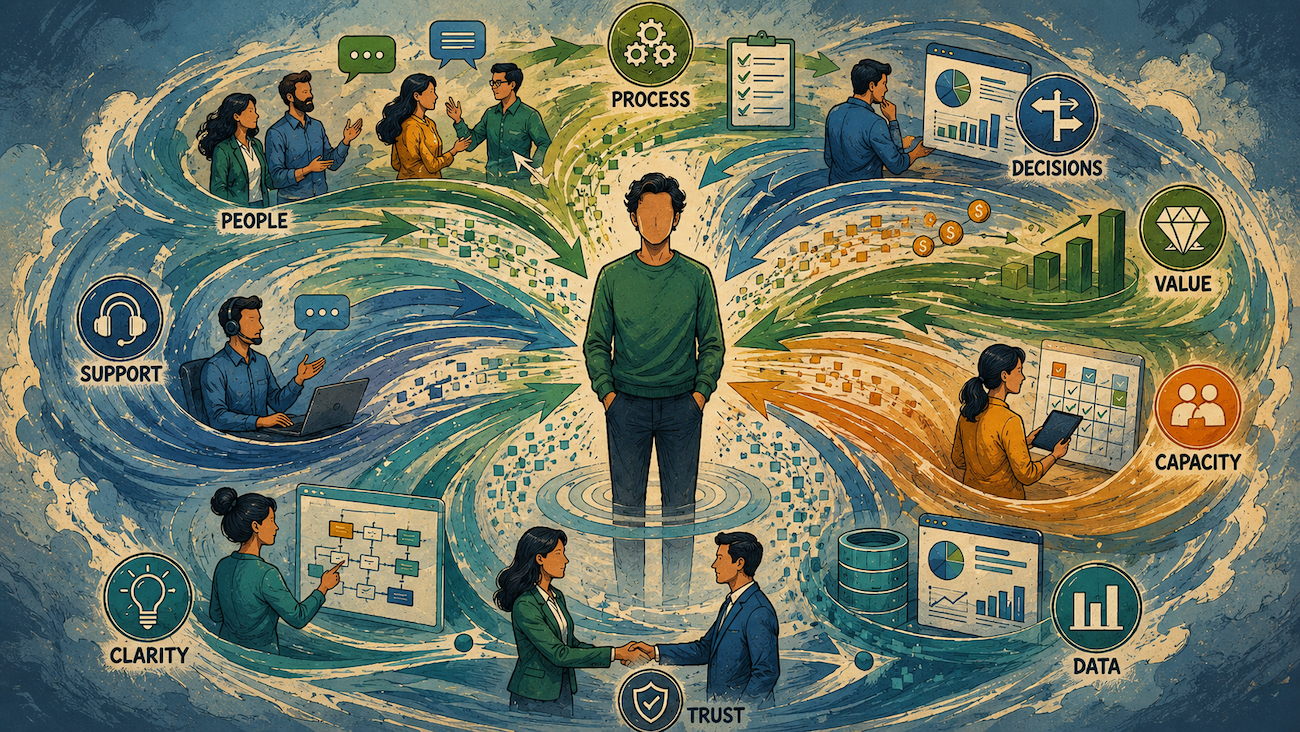
Is customer centricity real within the business you work? Not sure? Start by looking at the direction value travels. Resilient businesses shift value down to employees and the customers they serve. Potentially fragile businesses shift value up to executive bonuses and shareholders.
That line has been sitting with me because it connects two things businesses often separate: customer value and organisational resilience. Businesses love talking about customer centricity, purpose, values and long-term growth. The signal appears when the business is under pressure. Where does clarity go? Where does capacity go? Where does authority go? Where does strain go? Follow that movement and you will quickly see whether the customer is genuinely being served or simply being used as decorative garnish on the quarterly reporting buffet.
The direction of value tells the truth
Simon Sinek, in The Infinite Game, talks about finite and infinite thinking. A finite mindset optimises for the next quarter, bonus cycle, promotion window or leadership tenure. An infinite mindset considers the system that remains after this quarter, this leadership team and this particular strategy deck have finished tap-dancing across the boardroom table in a pair of shiny shoes nobody asked for.
It’s an important distinction because many decisions are dressed up as long-term strategy while quietly being made from a short-term extraction mindset. The language says legacy. The behaviour says, “How much can we pull out of this thing before the invoice for our decisions arrives with a small mushroom cloud attached?”
I spent 15 years in marketing roles, and does any other profession have as many sub-categories? Brand strategy, digital marketing, product marketing, campaign management, CRM, acquisition, retention, analytics, customer experience, and then inevitably some mysterious “growth” role that appears when someone senior has read a newsletter on a plane and returned convinced the business is one landing page away from becoming Apple.
Through all of that, you become quite attuned to the funnel. Awareness becomes interest. Interest becomes desire. Desire becomes action. Action, if the business has done its job properly, becomes loyalty. The funnel is essentially a model of value flow. Effort at the top exists to create value lower down. A customer-centric business understands that having a product does not create success. People need to know it exists, understand why it matters, want it enough to act, and experience enough value to return.
Business resilience has a similar flow. The difference is that the flow is purpose, clarity, energy, authority and capacity. Wrap that up neatly and we can call it value. A resilient business moves value down through the system so the people closest to the customer are equipped to create more of it. A fragile business pulls value up, asking more from the people below while sending less down to help them deliver.
Customer centricity is tested under pressure
That is why strain matters. Strain shows where value is getting blocked, absorbed or redirected before it reaches the customer. Overloaded middle managers may signal value trapped in coordination. Managers become human shock absorbers, quietly taking the impact while the organisation rolls downhill in a flaming shopping trolley full of OKRs. Under-capacitated frontline teams may signal customer value failing to reach the people it was meant for. Customer service teams constantly firefighting may signal upstream decisions creating downstream pressure. Executives insulated from lived reality may see a clean dashboard while the operating system quietly buckles behind them like a camping chair under a rhinoceros.
This is also why the phrase “customer centricity” has become mostly absolute rubbish. It belongs on quarterly reports, internal launch decks and executive escapes where everyone wears branded fleece and pretends the values workshop was a good use of a Tuesday. The real test arrives when customer value requires the business to give up internal convenience.
That is where the wheels usually start wobbling. Everyone agrees the customer matters. Everyone nods gravely at the slide. Everyone says the words. Then the decision protects internal convenience, margin, reporting, process or hierarchy first. It is customer centricity performed by a sock puppet with a PowerPoint clicker.
I have sat in those rooms. The customer was on the slide, in the language, and supposedly at the centre of the decision. Then the actual choice protected the process, the number, or the internal headache everyone wanted to avoid. The customer is held up as the centre of the business, then treated as a cost, a nuisance, a metric, a ticket, a complaint queue or a conversion point wearing a tiny hat labelled “Q3”. That is value flowing up.
Commercial performance matters. Businesses need growth, margin, discipline and financial health. Pretending otherwise is the kind of nonsense that gets printed on tote bags by people who have never had to make payroll. The issue is value direction. A business can make the numbers look good for a while by squeezing the system. Squeezed systems become brittle, resentful and expensive, like a budget airline seat that has been asked to support a rugby prop and his emotional baggage.
This is the part businesses often miss because they are too busy measuring outputs. Revenue, margin, conversion, productivity, engagement, retention and NPS all matter, but they usually show what has already happened. Strain tells you what the system is carrying to produce those outputs. It shows the load behind the number.
A business can hit the target and still weaken itself. It can deliver the quarter by spending trust, capacity, goodwill and energy it has no serious plan to replenish. It can call that success, provided the time horizon is short enough and nobody asks where the cost went. Which is convenient, because asking where the cost went tends to ruin the mood in the same way a dead raccoon ruins a jacuzzi.
Purpose should decide where value flows
Purpose should stop this drift. Purpose is the blueprint. KPIs are duct tape. Useful duct tape, to be clear, because sometimes duct tape is the only thing stopping the bumper from dragging along the N2 in a shower of sparks. But duct tape is still duct tape. It should hold things together temporarily, measure progress, reveal gaps and help the system stay honest. It should never become the thing the business is built around. Purpose should tell the business where value is meant to flow when trade-offs get uncomfortable.
If you want a simple customer experience strategy test, start with three questions:
- Does this align with our business purpose?
- What value does this create for the customer?
- What strain does this create in the system?
That third question matters because a decision can look smart in the boardroom and land like a piano on the people expected to deliver it. A resilient decision creates customer value without quietly overloading the people required to deliver it. Difficult decisions are part of business. Trade-offs are real. Constraints exist. The point is to see the full cost of the decision, including the human and operational strain that often gets hidden below the executive layer like a family of raccoons living in the ceiling.
Executives shape value flow through what they reward, protect, measure and tolerate. They decide whether clarity moves down or confusion does. They decide whether authority moves down or bottlenecks do. They decide whether teams receive capacity or another instruction to “do more with less,” the corporate equivalent of telling someone to tow a caravan with a toaster while six people from finance ask if the toaster can also produce weekly reporting.
The test of leadership is whether clarity, trust and capacity reach the people expected to serve the customer. When they do, value can move. When they do not, strain accumulates. People improvise around broken systems. Customer-facing teams apologise for decisions they did not make. Customers feel the gap between what the business says and what the business actually allows.
Customer experience is the final proof of value flow. Customers feel it in the speed of response, the usefulness of the answer, the amount of friction, the number of hand-offs, the quality of the product, the tone of the interaction and the willingness of the business to solve the actual problem.
Customers do not only experience your brand. They experience your strain.
The maths is not hard. Executives serve the system. The system serves the people doing the work. The people doing the work serve the customer. The customer sustains the business.
Reverse that flow for long enough and the business may still look successful on the dashboard, but it has already started becoming fragile.

The Resilience to Redefine Victory: Solveig Løvseth at IRONMAN Kona
Solveig Løvseth’s remarkable IRONMAN Kona finish reveals how resilience can mean changing course, recognising our limits and redefining victory.

Leadership Blind Spots: Would You Know If Pressure Changed the Way You Lead?
Leadership blind spots can grow under pressure. Learn how changing behaviour weakens feedback and leaves leaders unaware of their
Business Resilience: When People Stop Challenging How Work Gets Done
Business resilience can weaken while performance still looks fine. One early warning sign is when people stop challenging how[…]
One response
[…] Valorie Burton writes in Rules of Resilience: […]