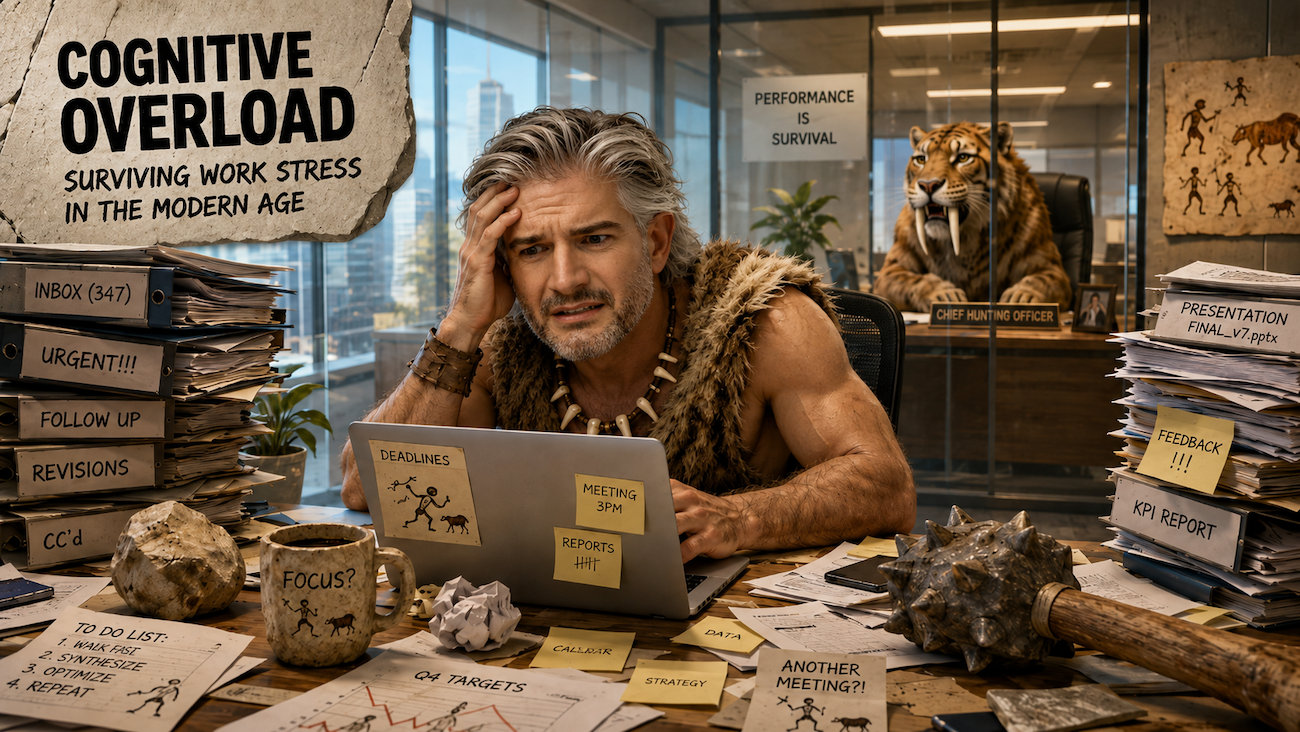
AI and cognitive overdraft is the conversation most businesses are not having yet. They are talking about productivity, efficiency, automation, headcount, speed and scale, but they are not asking what happens when AI increases output while the human capacity underneath the work quietly starts to drain.
For a moment I want you to imagine that you have just been hammered by your manager on work that was apparently “not quite what they wanted,” which is a fascinating phrase because it usually means the work is about as close to what they wanted as a toaster is to a dolphin. You walked into the meeting feeling confident. You had worked hard, thought about the brief, done the graft, and then watched the entire thing fall apart like a camping chair bought from a petrol station.
Then comes the instruction: “Can you get this fixed by midday?” Wonderful. You’ve spent a week building the thing, and now you have a few hours to resurrect it, perform emergency surgery, polish it, and make it look like this was always the plan.
Anyone who has worked for more than about eleven minutes has experienced some version of this. The late-stage change. The unclear brief. The manager who only discovers their opinion once someone else has finished the work. But the issue is not just the time pressure, although that is unreasonable enough to make a stapler look threatening. The bigger issue is cognitive capacity.
Or, more accurately, the sudden lack of it.
Beneath the frustration is something more uncomfortable: shame. Not dramatic, collapse-on-the-floor shame. Just that hot, private, professional version where your chest tightens and a tiny internal committee immediately starts asking whether you are actually terrible at your job. That emotional moment is not separate from the quality of your thinking. It changes the state from which you are now expected to produce high-quality work.
What is cognitive overdraft?
Cognitive Overdraft is what happens when organisations keep borrowing against people’s future thinking capacity to meet today’s output demands. It looks productive at first because the work still gets done, the deck still gets rebuilt, the campaign still goes live, and everyone can pretend the system is functioning. But underneath that visible output, the human capacity required for judgement, creativity, empathy and original thought is being quietly drained.
This is why AI and cognitive overdraft need to be understood together. AI can increase what people are able to produce, but if the organisation does not protect the human capacity required to think well, the technology becomes a multiplier of strain rather than a source of resilience.
In the immortal words of the Bloodhound Gang, “we ain’t nothing but mammals.” Mammals with laptops, standing desks, corporate values, password managers, and the ability to spend forty-five minutes choosing a Teams background. But animals nonetheless. Our brains were not designed for quarterly planning cycles, stakeholder feedback loops, or being told at 10:30 that the thing due at 12:00 needs to be “more strategic.” They were designed for survival.
When the brain perceives threat, the amygdala acts like an alarm system. It helps activate the body’s stress response, preparing us to fight, run, freeze or survive. That is useful when cousin Cecil is being treated as a prehistoric buffet by something with teeth. It is less useful when Karen from Finance wants the deck rebuilt before lunch.
The body is not being stupid when it does this. It is doing exactly what it was designed to do: protect you from threat. The problem is that many workplaces have become extremely good at triggering threat while still expecting people to produce calm, original, strategic thought on command.
Under high stress, the prefrontal cortex – the part of the brain heavily involved in planning, judgement, decision-making and impulse control – becomes harder to access. That matters because this is the exact part of the brain you need when you are being asked to think clearly and creatively. Stress can affect concentration, decision-making, memory and emotional regulation.
So now you are not just dealing with an unreasonable deadline. You are dealing with an unreasonable deadline from a compromised cognitive state, which is a bit like asking someone to calmly land a helicopter while bees are being fired into the cockpit.
AI inside an already strained organisation
This brings us to the thing businesses are about to get very wrong with AI. Because AI is extraordinary. I am not anti-AI. Quite the opposite. I use it constantly. It has radically increased what I can build, test, write, research, analyse and understand. Five years ago, many of the things I am currently building would not have made it past the “nice idea, shame about the budget” stage.
AI can increase capability, speed and access to leverage. McKinsey has estimated that generative AI could add trillions of dollars in annual value across the global economy, with meaningful productivity effects across functions such as marketing, sales, software engineering and customer operations.
The adoption curve is already moving quickly. McKinsey’s 2025 State of AI research found that 78% of respondents said their organisations were using AI in at least one business function, while 71% said their organisations were regularly using generative AI in at least one business function.
But that same research also points to the deeper issue. The value of AI does not come simply from dropping a tool into an already strained organisation and hoping magic falls out. McKinsey found that workflow redesign had the biggest effect on an organisation’s ability to see EBIT impact from generative AI, yet only 21% of respondents using generative AI said their organisations had fundamentally redesigned at least some workflows.
That gap matters. AI is arriving inside organisations that are already strained, already overloaded, already asking people to attend seven meetings before lunch and then wondering why the afternoon strategy session has the intellectual sharpness of a damp sock. The danger is not that AI exists. The danger is that leaders look at AI and see only output: more work, faster work, cheaper work, higher volume, shorter timelines, fewer people and better margins.
If AI is only used to increase output expectations without protecting the human capacity required to use it well, businesses are going to create Cognitive Overdraft at scale. They will borrow against the future thinking capacity of their people until the organisation looks productive on the surface and intellectually bankrupt underneath.
At first, it will look impressive. More gets done. More gets shipped. More reports get produced. More campaigns go live. More meetings produce more actions that produce more documents that produce more meetings, in a beautiful corporate ouroboros eating its own calendar invites.
But underneath that visible output, something starts to erode. People have less time to think, less space to question, less capacity to challenge weak ideas, less energy to care, and less ability to bring judgement, context, empathy, imagination and originality to the work. Those are not soft extras. Those are the things that make the work valuable.
This is where the performance conversation needs to mature. Output tells you what is being produced. It does not tell you what it is costing the system to produce it. A team can be productive and unhealthy. A department can hit targets while quietly burning through trust, energy and capacity. A business can increase output while reducing the quality of thought behind that output.
This is where burnout thinking becomes useful, not as a wellness slogan, but as a business risk. The World Health Organization classifies burnout as an occupational phenomenon resulting from chronic workplace stress that has not been successfully managed. It is associated with exhaustion, mental distance or cynicism toward work, and reduced professional efficacy.
That definition matters because it is not about people being weak. It is about work being poorly designed, poorly managed or chronically misaligned with human capacity. Burnout does not begin when someone collapses. It often begins much earlier, when the organisation keeps asking for high-quality thinking from people whose cognitive capacity has already been spent.
The better AI question
AI can either help solve that problem or make it far worse. Used well, AI gives people capacity back. It removes admin sludge, speeds up first drafts, helps organise thinking, reduces the blank page, tests angles, interrogates assumptions, summarises complexity and gets people to better starting points faster.
Used badly, AI becomes a productivity whip. It gives leaders a reason to expect more, faster, from the same already-strained human system, then dresses the whole thing up as innovation because apparently calling something “digital transformation” makes it sound less like someone taped a rocket to a shopping trolley.
That is not transformation. That is extraction with better tooling.
A business is not a machine that can simply be upgraded with a faster processor. It is a living system. Departments are not cogs. People are not plugins. Culture is not a decorative screensaver you update during onboarding. When you add speed to a living system without increasing recovery, clarity and capacity, you do not automatically get progress. You get strain travelling faster through the body.
This is why the real AI conversation should not be “How much more can we produce?” It should be “What human capacity does this give back?” Because the great strategic risk of AI and cognitive overdraft is that people start outsourcing not just the task, but the thinking.
If someone is overloaded, under pressure, unclear on expectations and given impossible timelines, of course they will lean harder on the tool. Of course they will ask AI to do more of the thinking. Of course they will accept the first decent answer. That is not a character flaw. That is what happens when the system creates Cognitive Overdraft and then hands people a machine that can generate fluent mediocrity at scale.
If enough people in enough companies do that, everything starts to sound the same. The same strategies. The same campaigns. The same leadership language. The same “unlocking potential” nonsense. The same beige paragraphs wearing a tiny hat that says “innovation.”
The tools are trained on what already exists. They are brilliant at pattern, synthesis and acceleration. But they do not care. They do not feel the tension in a room. They do not know that a customer is tired of being patronised. They do not understand the political scar tissue inside a leadership team. They do not notice when the technically correct answer is emotionally useless.
Humans do that. Or at least, humans can do that when they have enough capacity left.
McKinsey’s guidance for CFOs makes a useful distinction here. Generative AI can support value creation through automation, augmentation and acceleration, but it also brings risks around inaccuracy, hallucination, privacy, intellectual property, overreliance and the need for human review. In other words, the tool may be powerful, but it still requires people with enough judgement to know whether the output is useful, accurate, appropriate and worth using.
This is where leadership needs to evolve. The leader of the AI era is not the one who lacks technical fluency. It is the one who mistakes technical acceleration for organisational resilience. You can know how to use the tools and still damage the system. You can automate workflows and still exhaust people. You can increase production and still reduce value.
The businesses that win with AI will not be the ones that turn people into machine operators with anxiety and Slack notifications. They will be the ones that use AI to free people for the work only humans can do: judgement, empathy, creativity, ethical reasoning, sensemaking, relationship-building, original thought and contextual decision-making.
So go back to that person standing outside the meeting room, trying to rebuild a week’s work by midday with a nervous system full of alarm bells. Now give them AI. What happens next depends entirely on the system around them.
Used well, AI gives them space to think again. It helps them organise the mess, find a path forward, test options, regain clarity and return to the work with more capacity than they had before. Used badly, AI helps them produce something passable while the real human capability drains quietly out of the room.
The leadership test for AI and cognitive overdraft is simple. After introducing AI, ask what has increased. If only output has increased, be careful. If capacity, judgement, clarity and recovery have increased, you may actually be building something stronger.
So yes, use AI. Use it aggressively. Use it intelligently. Use it to remove waste, accelerate learning, improve decision-making and unlock capability. But do not confuse increased output with increased strength. Do not confuse faster work with better thinking. Do not confuse visible productivity with sustainable performance.
Because AI will not save organisations that are already bad at protecting human capacity. It will expose them faster.

The Resilience to Redefine Victory: Solveig Løvseth at IRONMAN Kona
Solveig Løvseth’s remarkable IRONMAN Kona finish reveals how resilience can mean changing course, recognising our limits and redefining victory.
Leadership Blind Spots: Would You Know If Pressure Changed the Way You Lead?
Leadership blind spots can grow under pressure. Learn how changing behaviour weakens feedback and leaves leaders unaware of their
Business Resilience: When People Stop Challenging How Work Gets Done
Business resilience can weaken while performance still looks fine. One early warning sign is when people stop challenging how[…]
3 Responses
[…] I arrived there while thinking about AI, and more specifically what happens when AI does not just change work, but removes some of […]
[…] But accountability is not self-flagellation. It is the ability to separate what happened, what belongs to you, what belongs to the system, and what needs to move next. Defensiveness makes sense. It just does not scale. What protects your ego in the moment can damage the system over time. […]
[…] miss half the load. You look at the calendar and wonder why you are exhausted, while ignoring the emotional admin quietly running in the background like malware with a Canva […]