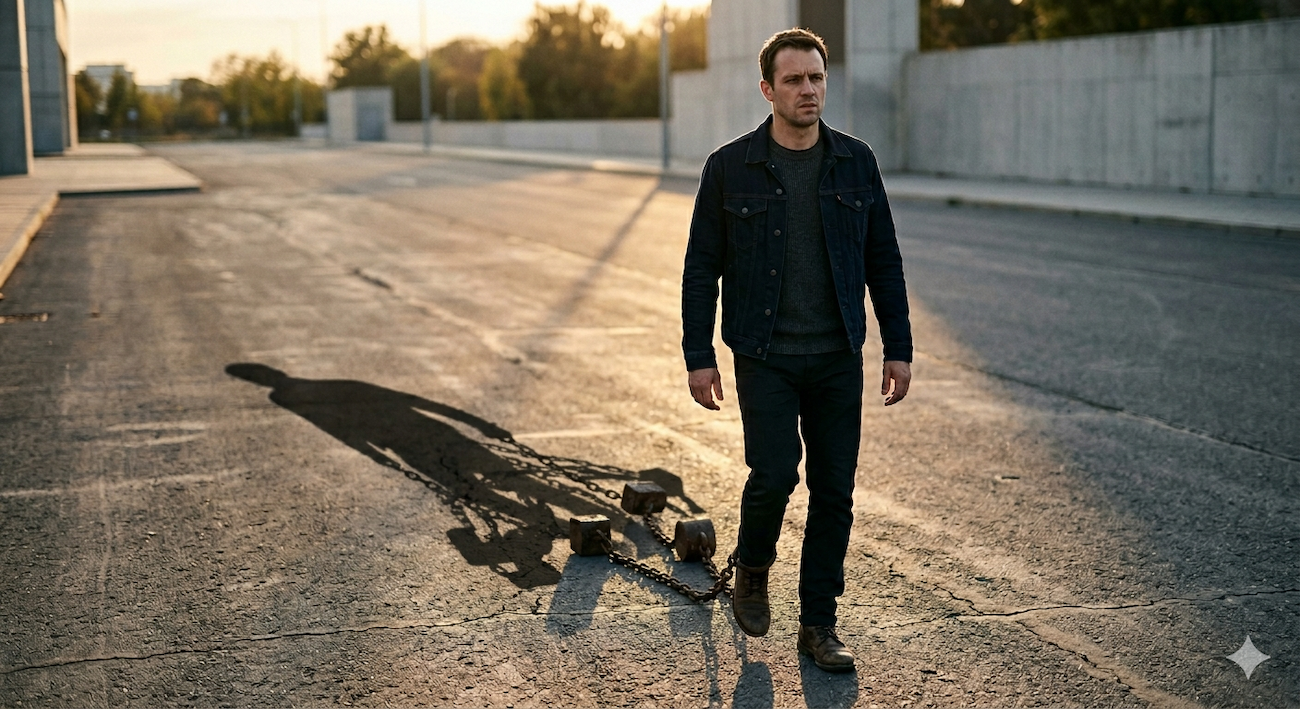
If I’m honest, this is a conversation I’ve avoided for a long time – not because I didn’t see it, but because I didn’t want to deal with it. A lot of it traces back to resilience and trauma, and how early experiences quietly shape the way you operate long after they’ve passed. In my case, that meant struggling with ADD, being bullied, and slowly deciding it was safer not to try.
ADD always made me feel like an outsider – like I’d somehow been assembled from spare parts while everyone else arrived fully factory-fitted. That feeling didn’t exist in isolation; it was reinforced by being bullied between the ages of six and twelve. Over time, a narrative formed. Not consciously, but persistently. That narrative said: you’re not capable of this, and if you try, you’ll be exposed.
So I stopped putting myself in situations that felt big, uncertain, or uncomfortable. Not because I didn’t want more, but because the version of me that had been shaped by those experiences believed it wasn’t available. What looked like caution from the outside was, in reality, protection.
Which works. For a while. Like using duct tape to fix a leaking pipe – it holds just long enough for you to convince yourself you’ve solved the problem. But over time, that turns into something else. You start building a version of success around things you can tolerate, not things that actually fit. Without realising it, you end up forcing yourself into environments, roles, and expectations that were never designed for how you’re wired.
For years, I thought the answer was more discomfort – push harder, toughen up, everyone else seems to manage so the problem, must be you. It turns out that’s only half true, because not all discomfort is useful. Some of it isn’t growth. It’s misalignment.
The misalignment we carry – often shaped by trauma – means we’re operating with less capacity than we think. Not because we lack resilience, but because part of it is constantly being used to hold things together that were never meant to be there in the first place. It’s like trying to run a marathon while carrying a backpack full of bricks you forgot you packed.
As we start to work through and resolve that trauma, something shifts. It’s not that life suddenly becomes easy. It’s that capacity comes back, and with that capacity comes the ability to take on things that previously felt out of reach. This is where emotional resilience after trauma becomes real – not theoretical.
Most of what I thought was a resilience problem was actually an alignment problem.
There’s a difference between building resilience and repeatedly placing yourself in environments that quietly drain it. That shift – from living with external discomfort to building internal acceptance – has been one of the more important changes I’ve made. But it also opened up a slightly more uncomfortable question.
If I’m not broken, what exactly have I been building my life around?
The Moment It Became Obvious
That pattern ran quietly in the background for years until it didn’t. The moment it surfaced properly was what I now think of as the Bohlingers Moment – sitting on the side of the Zambezi, beer in hand, reading Daring Greatly by Brené Brown.
It wasn’t dramatic. There was no cinematic soundtrack or sudden enlightenment with glowing light and slow-motion birds.
It was worse than that. It was clear.
I realised how much I was carrying that I didn’t need to. Not imposed externally, but maintained internally. And the impact of that was everywhere – work felt hard, life felt heavy, and the misalignment wasn’t isolated to one area. It was systemic. It was the first real moment of understanding how trauma affects resilience in a practical, lived way.
At that point, there were really only two options: continue down a path that was so clearly working brilliantly (it wasn’t), or choose something different – something guided not by tolerance, but by alignment.
That’s the context I took into a conversation with Roger Mulholland who runs training at Sanlam. What started as a conversation about resilience training didn’t stay there. It took a turn that, if I’m entirely honest, I had been circling for a while without wanting to confront directly – the effect of trauma on how we operate.
Roger suggested I pick up Man’s Search for Meaning by Viktor Frankl. The book is built around Frankl’s time in Nazi concentration camps during the Holocaust, and that context matters. His original manuscript was taken from him when he entered the camps, and much of what became the book – and his theory of Logotherapy – was conceptualised during and after that experience. This isn’t theory developed in comfortable rooms with decent coffee. It’s perspective forged under extreme conditions, which gives the ideas a weight that’s difficult to dismiss.
Early on, there’s a line that lands with uncomfortable clarity: “you cannot control what happens, but you can control how you respond to it”. It sounds reasonable until you realise what it demands. It asks you to stop negotiating with your circumstances and start taking responsibility for your direction.
This is where it becomes practical.
Frankl developed logotherapy as a way of shifting focus away from endlessly dissecting the past and toward something far less comfortable – responsibility for the future. Where psychoanalysis asks you to explain yourself, logotherapy asks you to orient yourself. Not what happened to you, but what you are going to do with it. This isn’t an attempt to reinterpret his work. It’s simply what started to make sense when I looked at my own patterns through that lens.
Tension, Direction, and the Quiet Collapse
One of the concepts Frankl introduces is what he calls “nöö-dynamics,” the tension between what you’ve already achieved and what you know you’re capable of achieving. That gap is uncomfortable, but it’s also necessary. It’s what drives movement.
But that only holds true if the tension is directed. When it’s aligned with meaning, it pulls you forward. When it isn’t, it does something else entirely. You either end up with uncontrolled growth – constantly doing more, but not necessarily moving closer to anything that matters – or you burn energy without meaningful output, working harder but not better. The difference isn’t effort. It’s direction.
Without that forward tension, people fall into what Frankl calls the “existential vacuum”. It’s not dramatic. It doesn’t announce itself. It’s just a quiet absence of meaning that shows up as drift. In that state, people default to one of two behaviours: doing what everyone else is doing, or doing what they think they’re supposed to do. Either way, the direction isn’t coming from them.
The cost of misalignment compounds quietly. The longer it goes unresolved, the more it takes. You become quietly miserable, but more importantly, it becomes harder to find your way back. The distance between where you are and where you should be grows, and with it, the effort required to close that gap.
Left long enough, something more concerning happens – you start to lose the very resilience you would need to change it. That’s the point I would never wish anyone to reach, because at that stage it’s not just work that’s affected. It’s everything – family, relationships, how you show up, how you think, how you operate in the world.
Frankl’s view is that meaning isn’t something you wait for. It’s something you build, and he outlines three ways people tend to find it:
- Creating a work or doing a meaningful deed – build something that matters, something that contributes beyond just getting through the day.
- Experiencing something or encountering someone – meaning isn’t just in what you do, it’s in what you feel and who you connect with.
- Choosing your attitude when faced with a situation you cannot change – even when you can’t change the situation, you still get to decide how you meet it.
That last one is the most confronting, because it removes the final excuse. Even when circumstances don’t shift, response still can.
So before you optimise anything else – your next move, your effort, your output – it’s worth asking a different question.
Not “how do I push through this?”
But “is this actually where I should be pushing at all?”
Because if it isn’t, no amount of effort is going to fix it.

Reactive vs Creative Leadership: The Upstream Driver of Organisational Resilience
Most leadership teams don’t fail from lack of effort, but from outdated behaviours. Learn reactive vs creative leadership and[…]

The Resilience Engine: Rethinking How We Build Resilience at Work
The Resilience Engine is a simple framework for building resilience at work. Learn how effort and meaning shape energy,[…]
How to Build Resilience That Actually Lasts
Most advice on how to build resilience focuses on reacting to pressure. Learn how to build resilience that actually
No responses yet