One of the most fundamental lessons I’ve picked up since moving deeper into the resilience space is just how much our rational thinking is shaped – and occasionally dragged into a dark alley and mugged – by our emotions.
Now, I know what your rational brain is doing as you read this. It’s doing that smug little head tilt and going, “Murray, you idiot. Obviously emotions and rational thought are related.” And yes. Of course they are. The problem is that we think we operate like calm, well-lit spreadsheet people… when most of us are actually emotional raccoons in a trench coat, pretending we’re fine.
So here’s the real question: do you actually operate rationally… or do most of your important decisions come down to what feels safe, what feels risky, what feels uncomfortable, or what feels like it might get you publicly grilled in a meeting while someone says, “Just to clarify…” in that tone that means, “I would like to peel your soul like an orange.”
Why change management fails despite good strategy
Let’s make it practical. If I told you we should move R1m from Sales into a long-term marketing awareness campaign because, over time, it will pay dividends – would you sign it off?
Probably not. And not because the logic is wrong. You might even agree with the data. The problem is that Sales takes a knock now. Targets wobble now. And someone, very possibly you, has to stand up in a meeting and explain that decision now, while everyone stares at you like you’ve suggested replacing the company cars with hoverboards to “drive agility.”
And if you’re in Sales and you’ve already felt the urge to check out at this point – congratulations. That little spike of irritation? That defensive “yeah but”? That internal eye-roll? That is your emotion showing up in real time. Not evil. Not dumb. Protective. Reacting to perceived threat before the rational part of your brain has even finished clearing its throat.
The long-term upside lives in the rational mind. The short-term consequences live in the emotional one. And in real organisations, the emotional system doesn’t just have a vote – it owns the building.
We love framing this tension as “risk averse versus risk takers.” It’s catchy. It fits neatly on a slide. But it misses the point. It’s not really about bravery. It’s about which internal system is driving in the moment.
What we call “risk takers” are often just people who can tolerate emotional discomfort long enough for a rational plan to play out. And what we label “risk averse” is often an emotional system doing exactly what it evolved to do – protect status, reputation, belonging, and the very real fear of being That Person Who Did The Thing That Didn’t Work.
This is also where self-awareness gets slippery. Most of us believe we understand why we do what we do. We have a narrative. It sounds rational. It’s beautifully presented. But very often we’re only holding a partial picture and mistaking it for the full truth – like confidently describing an elephant because you’ve touched its tail for seven seconds and now you’re basically a wildlife documentary.
The Elephant and the Rider: the psychology behind decision making
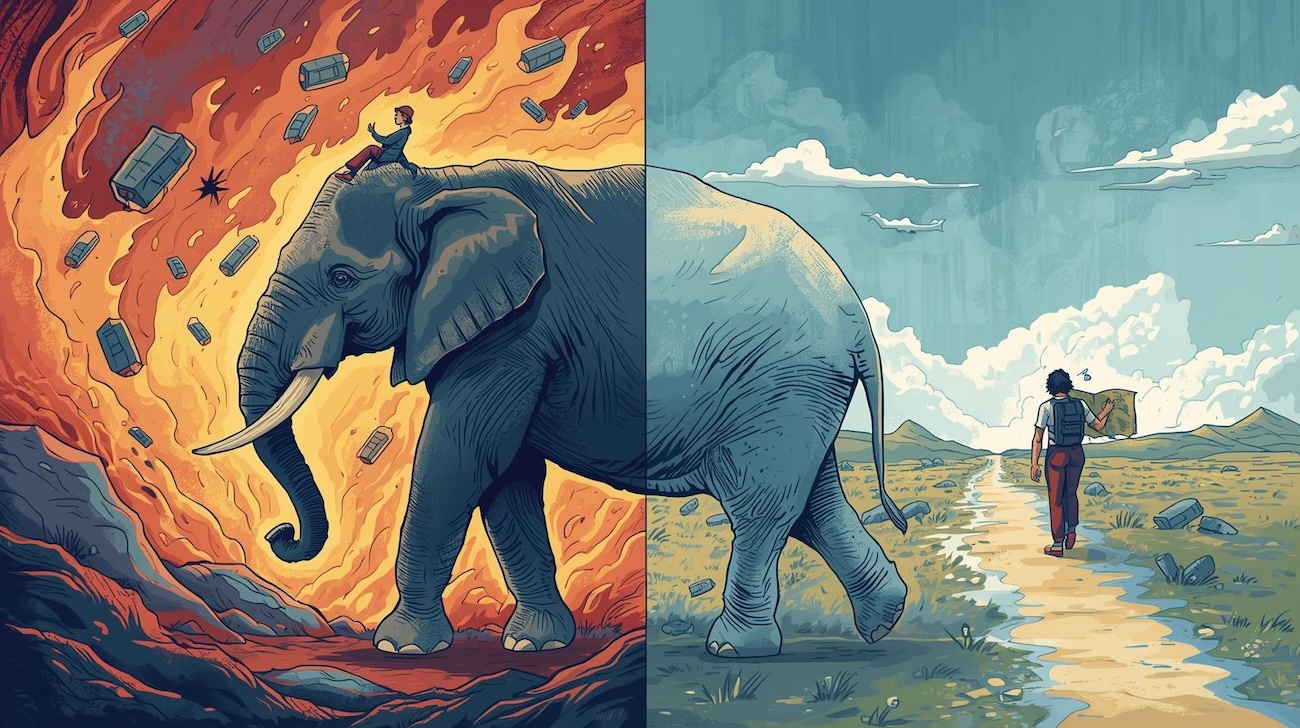
I’ve been reading Switch: How to Change When Change Is Hard by Chip and Dan Heath, which draws on work by psychologist Jonathan Haidt. They describe our internal world using a wonderfully accurate metaphor: the Elephant and the Rider.
The Rider is your rational, planning mind. The Elephant is your emotional, instinctive side. The Rider sits on top holding the reins and looks like the one in charge.
But that control is precarious at best. Because when the Rider and the Elephant disagree, the Elephant wins. Always. It’s like trying to steer a freight train with a strongly worded email. Technically you’re doing something… but not enough to change direction.
This isn’t just a charming metaphor, it explains a stubborn and expensive reality. For decades, research referenced by firms like McKinsey have shown that around 70% of organisational change initiatives fail to achieve their intended outcomes. What’s more uncomfortable is that despite better tools, smarter leaders, and enough frameworks to fill an airport bookstore, that failure rate has barely shifted in over thirty years.
In other words, we’re not failing at change because we lack intelligence, strategy, or effort. We’re failing because we keep designing change for the Rider – and ignoring the Elephant.
Why logic alone never changes behaviour
Important clarification: the Elephant isn’t childish or irrational. It’s protective. It’s tuned for safety, comfort, belonging, and immediate payoff. It’s the part of you, and the people you lead, that worries about being blamed, losing credibility, missing targets, disappointing others, or being the person who made the call that didn’t work out.
The Elephant does not care that your spreadsheet shows a return in twelve months. The Elephant cares that your reputation might take a knock on Tuesday. The Elephant is not thinking, “What’s best for the business?” The Elephant is thinking, “Will I survive the meeting?”
This is why change efforts collapse under the weight of good intentions. Change almost always demands short-term sacrifice for long-term gain. Have the uncomfortable conversation now for a stronger team later. Accept a dip today for a lift tomorrow. The Rider understands the destination. The Elephant negotiates the pain. And when the pain is immediate while the reward is abstract, the Elephant defaults to safety. It doesn’t sabotage, it panics politely and calls it “pragmatism.”
The Rider does have strengths. The Rider can plan, analyse, model the future, and delay gratification. But the Rider has weaknesses too – most notably overthinking. Analysis paralysis. Endless debate. Perfect logic with no movement. The Rider can generate endless reasons. The Elephant quietly decides whether you move.
Resistance to change isn’t laziness. It’s human
Scale this dynamic up and you get organisational behaviour. Teams are not collections of purely rational actors. They are groups of Elephants responding to pressure, incentives, and perceived risk… with Riders on top trying to keep things professional and pretending nobody is stressed.
The results show up clearly in the data. According to workplace research by Gallup, only around 21% of employees globally are engaged in their work. The majority are disengaged, and a meaningful minority are actively disengaged. Gallup also shows that managers account for up to 70% of the variance in team engagement.
Disengagement isn’t laziness. It’s what happens when Elephants stop believing the journey is safe, worthwhile, or fair.
And the cost of ignoring this reality is staggering. Gallup estimates disengagement costs the global economy between $8 and $9 trillion every year – roughly 9% of global GDP. That’s not a wellbeing footnote. That’s one of the largest operational inefficiencies in modern business.
This is usually the point where someone says, “So it’s all very soft.” Yes. These are soft skills. And yes. They will absolutely eat your outcomes alive if you ignore them.
Because if we only speak to logic, we’ll win arguments and lose behaviour. If we only pull emotional levers, we’ll get short bursts and no follow-through. Sustainable change requires engaging both systems – rational direction and emotional safety.
How leaders influence decisions that actually stick
So here’s a simple challenge, whether you’re leading a team or navigating your own next move: pay attention to who’s driving your decisions. Are you choosing the easier option because it reduces discomfort now… or are you choosing the harder option because you know it pays later?
Easy now, hard later.
Hard now, easy later.
But here’s the bigger point – it’s not just about recognising who’s navigating your decisions. It’s about learning how to influence decisions in other people too. Because when you’re trying to move a decision – in a boardroom, a team meeting, or across the dinner table – you’re not persuading a single rational mind. You’re speaking to a Rider and an Elephant. The Rider wants logic, clarity, trade-offs, and a plan. The Elephant wants safety, dignity, belonging, and to not feel like it’s about to be hunted for sport.
If you only appeal to the Rider, you’ll get nods… and no movement.
If you only appeal to the Elephant, you’ll get emotion… and no follow-through.
Real influence is cognitive and emotional. It’s the art of helping the Rider see the road while helping the Elephant feel safe enough to walk it.
Once you can see the Elephant and the Rider clearly, you stop fighting yourself — and start designing change that actually moves.
No responses yet