
Several years ago, someone gave me a copy of Matthew McConaughey’s Greenlights. Until then, I’d never read an autobiography. Probably jealousy, if I’m honest. Some people have lived genuinely remarkable lives, and apparently my response had been to avoid reading about them. I’ve since learnt my lesson.
McConaughey writes about his unconventional upbringing, his family and his unlikely journey into Hollywood, where he eventually became the undisputed champion of romantic comedies. If a film needed a charming Texan to remove his shirt, smile at a woman and make questionable behaviour seem endearing, he was Hollywood’s man.
He was enormously successful. And then he decided he wanted something else.
He began turning down romantic comedies, including a lucrative offer that reportedly reached $14.5 million, and spent roughly twenty months out of the spotlight waiting for different roles. The Lincoln Lawyer, Mud, Dallas Buyers Club and True Detective eventually followed. He went from the bloke taking his shirt off on a beach to a detective contemplating the meaninglessness of human existence. Quite a career adjustment.
What resonated with me so deeply at the time was his willingness to reconsider a career that, by almost every conventional measure, was working. He’d developed enormous expertise, but the roles available to him no longer represented the work he wanted to pursue. And he was prepared to risk what he’d built to explore something different.
Over time I have begun to think about decisions through something we don’t pay enough attention to: the flow state. More specifically, what happens when the activities that once brought us into flow stop delivering it, and what that might teach us about long-term personal resilience.
Why three hours can disappear in an instant
Psychologist Mihaly Csikszentmihalyi spent decades studying the flow state: the experience of becoming so absorbed in an activity that our concentration intensifies, our sense of time changes and the activity feels rewarding in its own right.
We recognise it from playing sport, making music, writing, building something or solving a complicated problem. We look up and discover that three hours have passed, with no reasonable explanation beyond someone having tampered with the clocks.
Neuroscience is beginning to explain some of what happens. Studies implicate brain systems involved in attention, self-monitoring and reward, although researchers are still working out precisely how they interact. Dopamine is relevant to motivation and learning, but it’s not a magic substance that switches flow on whenever something feels pleasurable.
Consider doomscrolling. We can spend an evening flicking between global catastrophes, arguments with complete strangers and a golden retriever apparently earning more than the entire accounting department. Novelty and unpredictable rewards can keep us scrolling, but being occupied isn’t proof that we’re in flow. If scrolling is the only thing that seems to hold our attention, I’d suggest deleting the apps for a while and seeing what else has been crowded out.
The flow state usually involves active engagement with something that asks something of us. One important ingredient is the relationship between the challenge we’re facing and the skills we bring to it.
Flow state: When challenge meets capability
When our skills exceed the challenge by a considerable margin, boredom becomes more likely. We’ve done the task so often that we can practically complete it while planning dinner. When the challenge feels far beyond our abilities, anxiety and overwhelm can interfere with our concentration.
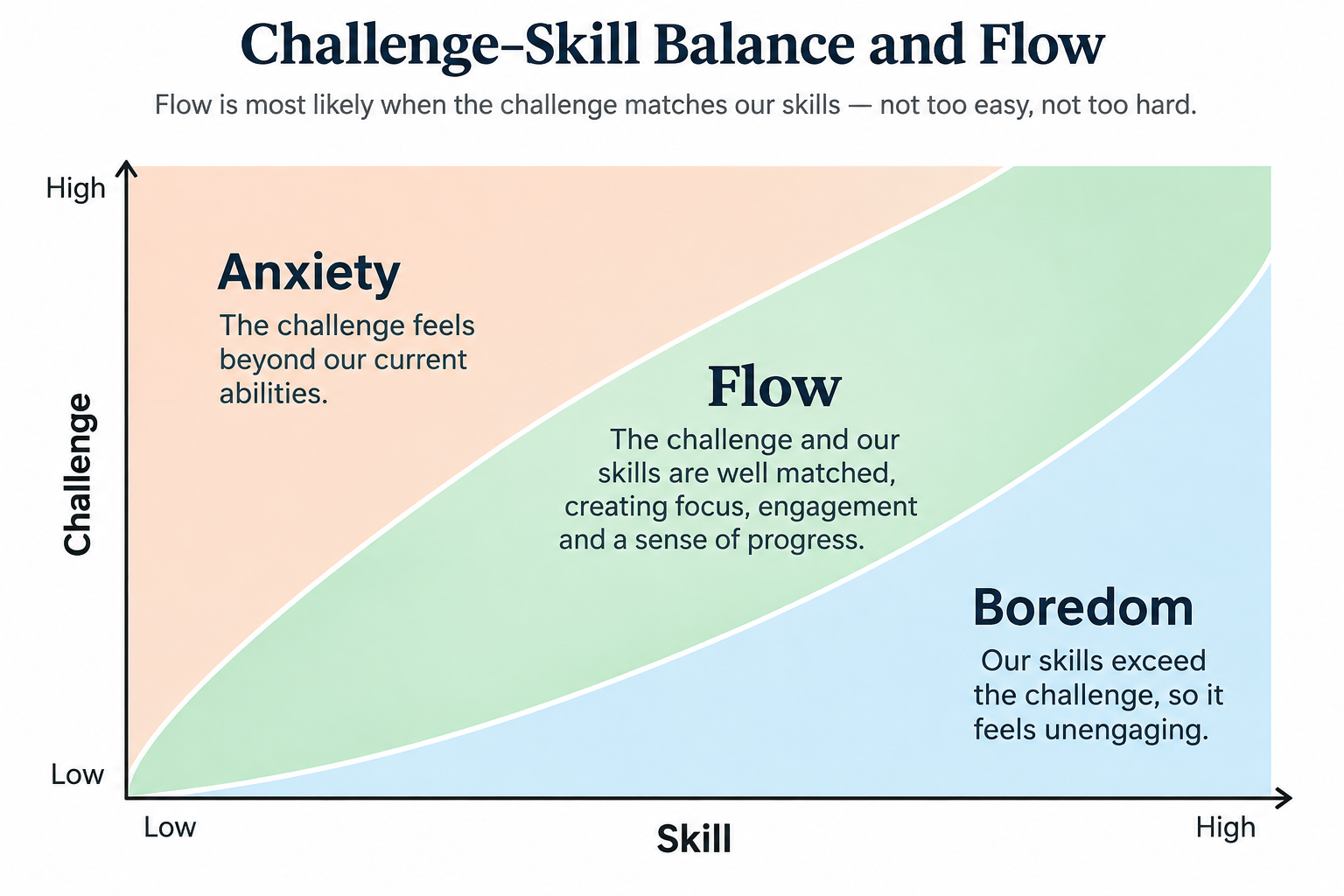
The graph isn’t a psychological sorting hat. Anxiety and flow can coexist. We might feel nervous before presenting to a packed room, then become completely absorbed in reading the audience, adjusting our delivery and responding to whatever happens. High stakes and deep engagement aren’t opposites.
In Atomic Habits, James Clear describes the Goldilocks Rule: we’re often most motivated by tasks near the edge of our current abilities. His discussion of deliberate practice adds an important complication. As we improve, yesterday’s challenge becomes today’s routine. We may need to stretch our abilities further to remain engaged.
Clear also acknowledges the less glamorous side of mastery: repetition and boredom are unavoidable. We can’t declare an activity dead every time it fails to produce fireworks. Sometimes the work is to practise, recover, learn a harder technique or get through an unremarkable Tuesday.
But sometimes our capabilities, interests or circumstances have moved on, and the activity no longer offers what it once did. Recognising which situation we’re in takes rather more self-awareness than another productivity hack.
A career I knew how to do
I spent around fifteen years in marketing. I enjoyed the data, statistics, problem-solving and communication, and worked with some remarkable people. At GetSmarter, I loved helping create educational experiences and discovered how much I enjoyed studying and research. I’ve also maintained several blogs over the years. This is the fifth, by my count. I’ve long enjoyed both the writing and the systems that let me publish it.
Looking back, the thread wasn’t necessarily marketing. It was learning, investigating, creating, understanding systems and solving problems. Marketing happened to be where I’d spent years doing those things.
Eventually, though, I couldn’t see myself remaining in that field for the rest of my career. I wasn’t necessarily bored, and the skills I’d developed hadn’t lost their value. The work simply wasn’t engaging me in the same way. I could see limits to how long I could sustain that trajectory without finding different opportunities to grow.
For years, immigration restrictions had kept me in marketing roles. That was where my experience could secure the employment I needed, so changing careers wasn’t a realistic choice. When my immigration circumstances finally changed, the choice opened up: stay with the familiar or take a chance on work I hadn’t yet figured out.
I chose the unknown, but I didn’t make the decision on a whim. I’d saved enough to give myself a financial runway. It wasn’t unlimited, and I knew there was no guarantee of what would happen before it ran out. That preparation made the leap possible.
Then I threw everything at it. I completed courses, buried myself in research, learned new skills and started building things I’d previously only been curious about. It has been financially uncomfortable and, at times, intensely anxiety-inducing. Being engaged by the work hasn’t magically paid the bills.
But I’ve found flow in reading, writing, research, building technology and playing my guitar. When there’s enough meaningful work and exploration going on, I close my eyes and somehow a week has disappeared. Those activities look different, but they repeatedly give me opportunities to learn, create and solve problems. Recognising that pattern has started changing the decisions I make.
For me, the relationship between flow state and personal resilience is becoming increasingly practical. I can recognise what engages me, even as the circumstances around my work continue to change.
Two offers, and the answer I found at 3 a.m.
In one week, I received two invitations to contribute sweat equity to two separate products. I declined both, for different reasons.
The first was an online learning platform I’ve been building with AI-assisted development tools. I love the build: solving technical problems, understanding how systems connect and discovering why something that worked five minutes ago has suddenly decided that functioning is optional. Hours disappear. That’s flow for me.
But equity would change my relationship with the business. I need cash flow rather than speculative future returns, and an ownership role could draw me into marketing, content and commercial growth. I enjoy building the platform. I don’t want to become responsible for all the other things that come with running it.
The second offer bothered me more. It was an interesting app idea with commercial potential, and rationally I could make a case for getting involved. Yet there was a voice in the back of my head going, ‘Nope. Nope. Nope.’
At around three o’clock one morning, while conducting another completely unnecessary meeting with my own brain, I finally understood it. Someone else was already building the technology. The only part of the opportunity I’d really have enjoyed was taken care of.
My contribution would mean returning to an industry I’d spent more than a decade in, alongside the marketing work I’d spent roughly fifteen years doing. I have both T-shirts. Neither needs replacing.
I could picture the first few months: the excitement, the ideas and the momentum of something new. I could also picture what would happen when that novelty faded. I’d be doing work I already knew how to do, in a world I’d worked hard to move beyond.
Neither was necessarily a bad product or a bad opportunity. But I could now distinguish an opportunity that looked promising from a role I actually wanted. The relief of understanding why I’d been so reluctant was enormous.
The ingredients matter more than the activity
Here’s what I think we need to remember about the flow state: an activity that brings us into it today may not do so forever.
Our skills improve. Our interests change. The circumstances around the work shift. We might need a greater challenge, more autonomy, some recovery or an entirely different pursuit. It makes little sense to expect one job, hobby or project to keep engaging us in exactly the same way for decades.
So when the feeling starts fading, we can investigate what made the experience absorbing in the first place. Was it learning something difficult? Creating? Working independently? Understanding a system? Seeing an idea become real?
Those ingredients can travel. The satisfaction I once found in analysing marketing data and solving communication problems now appears in research, writing and software development. I haven’t discarded the old capabilities. I’m applying them to different challenges.
This builds on something I’ve written about before in Self-Awareness: Or Why You’re Probably Just Fondling the Elephant’s Tail. Understanding our strengths and motivations gives us a starting point. Recognising the conditions that produce flow helps us work out how to use them as we change.
Clear’s Atomic Habits offers a practical way to approach this without needing a dramatic career change. Small repeated actions build capabilities, and periodic reflection helps us notice when our routines are no longer taking us where we want to go. His observations about identity matter here too: we can become so attached to being known as the marketer, manager or specialist that we overlook what else we could become.
I had saved enough to attempt a major change. Many people don’t have that option, and not every season of life leaves us room for much experimentation. But the size of the change isn’t the point. It might be a different responsibility at work, half an hour with a guitar, a book outside our usual interests or a small project we make room for each week. There’s no guaranteed transformation, but the experiments give us information, practice and possibilities we didn’t have before.
I’ve explored this broader process in Resilience Through Reinvention: Upgrade Your Career System. We can develop new capabilities without treating everything we’ve already learnt as something to throw away.
And change them
My mother used to tell us, ‘Don’t stress about the things you can’t change. Stress about the things you can.’
I’ve always thought that was sound advice, although I’d add one final instruction: And change them.
We can start by recognising when we experience a flow state, then understanding what created it. From there, we can look for practical ways to create more of those conditions within the time, money and responsibilities available to us. And when the experience changes, we review what happened rather than automatically abandoning it or forcing ourselves to persist forever.
Sometimes the next step is to practice harder. Sometimes it’s to rest. Sometimes it’s fifteen minutes on a Tuesday, and sometimes, if circumstances allow, it’s a much larger leap.
McConaughey recognised that an extraordinarily successful chapter no longer offered the roles he wanted. I eventually recognised that the work I’d built a career around no longer offered the growth I needed. Our previous chapters still matter; they’ve given us the skills to approach the next ones.
Finding flow is wonderful. Understanding what creates a flow state gives us something potentially more durable: the ability to keep looking for it as we change, and another way to practise personal resilience over the long term.
The Era of Standard Deviation: Why Business Must Rethink Success
I’ve started writing this blog about half a dozen times. Not because I don’t know what I want to[…]
The Resilience to Redefine Victory: Solveig Løvseth at IRONMAN Kona
Solveig Løvseth’s remarkable IRONMAN Kona finish reveals how resilience can mean changing course, recognising our limits and redefining victory.
Leadership Blind Spots: Would You Know If Pressure Changed the Way You Lead?
Leadership blind spots can grow under pressure. Learn how changing behaviour weakens feedback and leaves leaders unaware of their
No responses yet