A friend recently sent me an article from Centric Wealth titled “Why are more people building ‘Career Insurance’?” The WhatsApp came with the message: “Don’t know why, but this made me think of you…” And I imagine anyone who has half a clue about what I’ve been doing since I left corporate two years ago would see the similarities. One line in particular landed heavily with me: “Between the ages of 35 and 55, you are often at the peak of your career and earning capability.”
YES. There was much more going on in my world that I hadn’t previously been able to resolve – the visa issue predominantly – but professionally, this was pretty close to where I found myself. I’d worked for 15 years in marketing roles and had reached a point where it increasingly felt like more of the same. The opportunity to grow felt smaller, while the effort involved seemed exponentially greater than the reward that would come from it.
I felt like I had hit my professional ceiling within marketing. I no longer had the drive to become a Chief Marketing Officer or anything of the sort. It just didn’t appeal to me, and when something doesn’t appeal there’s no amount of drive that is going to get you over the line.
The Centric Wealth article focuses largely on diversifying income alongside a full-time role. I understand the logic, but I’m more interested in diversification of capability and how that can build career resilience.
And that made me think about T-shaped skills.
What are T-shaped skills?
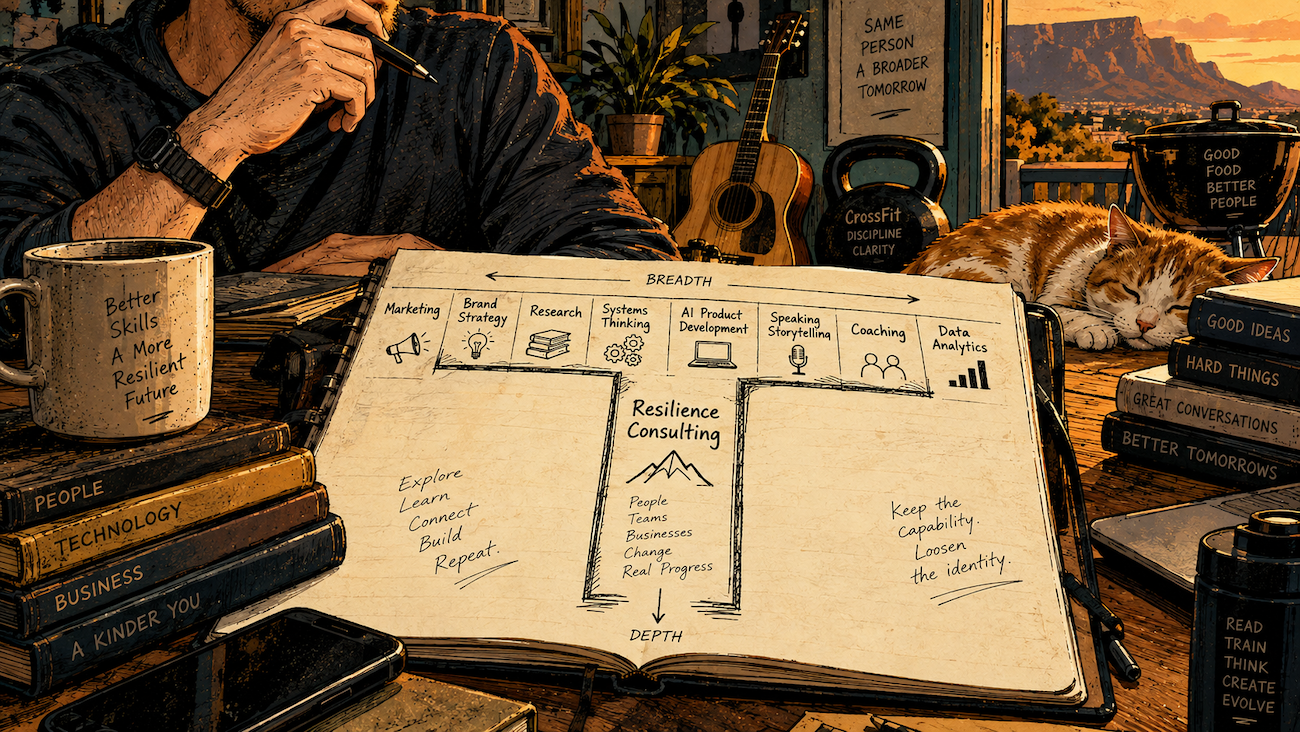
I first came across the idea in Richard Mulholland’s Relentless Relevance. Think of your professional capability as the shape of a T.
The vertical is your depth: the area you have spent years becoming genuinely good at. Your experience, expertise and accumulated knowledge sit there. It is your bread and butter; the thing that keeps the lights on and the kids locked safely in a classroom during the day.
Across the horizontal sits your breadth. These are the other capabilities you accumulate, experiment with and gradually develop.
Some may become commercially useful, some may make your vertical more useful, and some may simply start as something you are curious enough to play with. Mulholland describes the aim as being “master-ish” in a range of things while maintaining deep mastery in one.
T-shaped skills are not an argument against specialising. The vertical still matters enormously; the risk is allowing it to become the boundary of your professional usefulness.
I’ve written previously about generalists and specialists in the age of AI. T-shaped skills give me a slightly different way of looking at the same tension: retain the depth you spent years building while deliberately widening the capabilities available around it.
My own T looks very different to what it did two years ago
If I drew my T today, the vertical would be resilience consulting. I spend more time on it than anything else: reading, researching, studying, building and speaking about resilience, with the goal of helping businesses become more resilient by strengthening the resilience of their people.
My previous 15 years in marketing haven’t disappeared. That capability still informs how I communicate ideas, build products, understand customers and take something relatively complicated and try to make it useful.
Around that has grown AI product development and speaking. Then there is guitar, which I started learning after leaving corporate and which nobody should currently attempt to turn into a source of income by hiring me for their wedding.
Not every skill across the top of your T needs to arrive with a revenue target attached to it. Some of it can just be exploration.
The bigger problem may be identity
Rereading Atomic Habits recently, one line jumped back out at me: “When you cling too tightly to one identity, you become brittle.”
There is a difference between saying “I work in marketing” and gradually reaching the point where you believe “I am a marketer.” One describes the work you currently do; the other can start defining what you believe you are qualified or capable of doing next.
I had 15 years of evidence telling me that marketing was the thing I knew how to do. It was where my experience sat, where my CV made sense and where I could most easily explain my value.
The problem was that I no longer particularly wanted the future that came with it. I’ve written more about that process of trying to find work that actually fits you, but at the time most of my professional history was pointing me towards exactly the thing I no longer wanted to keep doing.
You can become extremely good at something and then discover that the thing you worked so hard to become good at is making it harder to imagine yourself doing anything else. We spend years accumulating experience, being rewarded for it and becoming known for it, and it becomes very easy to mistake what we have become good at for the boundary of what we can become good at.
Learning also means unlearning
In Relentless Relevance, Mulholland references Derek Sivers, entrepreneur and author of How to Live, and a line of his that caught me: “Learning leaves a trail of little deaths.”
We talk endlessly about lifelong learning, but far less about what learning sometimes requires us to leave behind. New capability can ask you to become a beginner again and admit that something which served you incredibly well for ten or fifteen years might not be the thing you want to spend the next ten doing.
It can also require you to loosen your grip on a title, status or identity you worked hard to earn. That doesn’t mean those years were wasted; I didn’t throw away 15 years of marketing experience when I changed direction because much of what I am doing now relies on it.
What had to change was my attachment to marketing as the answer to the question, “What do you do?”
Keep the capability. Loosen the identity.
Explore until you find something worth exploiting
There is another idea from Atomic Habits that fits almost perfectly with T-shaped skills: explore and exploit. Exploration is where the horizontal starts. Try things you are not yet good at, follow curiosity, build something, learn a tool or take on a project that sits outside the work you normally do. Most of those explorations probably won’t become meaningful parts of your T, and that is fine. Exploration is not about turning every curiosity into a career; it is how you discover which ones deserve more attention.
Then something starts to line up. You keep coming back to it, it connects naturally with skills you already have, you solve something useful with it, somebody notices, or somebody asks you to do more.
That is the signal, and when you get it you exploit, exploit, exploit. Spend more time on it, practise it, build with it, use it in real situations and find out how far you can take it.
AI product development happened that way for me. I explored it because I wanted to build Antistable, learnt enough to make something work, showed it to people and then had people ask whether I could build things for them too.
That was the signal. Exploration had earned the right to become exploitation.
Clear uses a working ratio of roughly 80% exploit and 20% explore. I like that as a way of thinking about skill development too: most of the effort goes into capabilities that have already shown enough value to deserve deeper investment, while enough space remains protected to discover what might come next.
Explore broadly enough to find alignment, then exploit the hell out of what aligns.
Why widen the top of the T?
Mulholland gives four reasons for widening the horizontal part of T-shaped skills:
Adaptability: a broader capability base gives you more options when circumstances change. You do not need to predict exactly what happens next; you simply want more than one thing to grab onto if the floor moves underneath the capability you currently rely on.
Collaboration: you do not need deep expertise in every adjacent discipline, but understanding enough of another field changes the questions you can ask and the conversations you can participate in. Breadth does not replace specialists; it helps you work with them.
Innovation: different capabilities can start becoming useful together. My own work now sits across resilience, product, technology, marketing and communication, not because I mapped that combination in advance, but because different things I explored started connecting.
Employability: if all of your professional usefulness relies on somebody needing exactly the role you have spent years specialising in, your options narrow when that need changes. A wider T does not give you guarantees, but it does give you more genuine capability to work with.
Isn’t this just becoming mediocre at everything?
There is an obvious counterargument. We have spent decades hearing that specialists are valuable because they have depth, and there is a very real danger in spending your life chasing whatever new skill, trend or piece of technology has just appeared.
Mulholland makes this point too: trends do not automatically equal relevance. This isn’t an argument for collecting certificates like Pokémon cards, nor is it an argument for becoming vaguely competent at 40 things and excellent at none of them.
That is why the vertical exists. Your deep capability remains important; the goal is to allow new capabilities to accumulate around it and, over time, make what you already know more useful.
Depth without becoming trapped by it. Breadth without becoming distracted by it.
Build T-shaped skills before you desperately need them
If you only start broadening your capabilities once the thing you currently do stops working, you are starting from a very different position. I’ve written before about resilience through reinvention and building career adaptability; the same principle applies here.
The alternative is less dramatic. Keep developing depth while protecting enough curiosity and space to explore what else might become useful.
You do not need to correctly predict what your career will look like in ten years. You do need to avoid becoming so attached to what you do today that you stop developing options for tomorrow.
So, what does your T look like?
Start with your vertical. What have you genuinely spent enough time doing that you have meaningful depth?
Then look across the horizontal. What capabilities have you accumulated through previous jobs, projects, hobbies, interests or things people repeatedly ask you to help with? What have you stopped counting because it no longer forms part of your job title?
Where does your curiosity repeatedly take you, and what have you already started exploring without thinking of it as career development? Perhaps most importantly, what professional identity are you holding onto because you spent so many years earning it?
I’ve created the prompt below to help. Paste it into ChatGPT/Claude/Gemini and let it interview you one question at a time:
T-Shaped Skills Career Resilience Prompt
Help me identify the T-shaped skill profile I should deliberately build to increase my career resilience.
Start by interviewing me one question at a time about:
- my current role and industry
- the capabilities where I have genuine depth
- previous skills and experience I may now undervalue
- work that gives me energy or flow
- subjects I repeatedly become curious about
- skills I have started developing outside my main profession
- problems people already ask me to help solve
- areas where I may be overly attached to my professional identity
- assumptions about my career I may need to unlearn
Once you have enough information, identify:
- My vertical: the capability where I currently have the greatest meaningful depth.
- My existing horizontal: skills and experiences I already possess but may not recognise as part of my professional value.
- Three skills worth exploring: adjacent capabilities that build logically from what I already know rather than simply following trends.
- Why each matters: assess each against adaptability, collaboration, innovation and employability.
- My identity trap: where an existing title, skill or professional identity may be limiting what I believe I can become.
- What I may need to unlearn: assumptions or old definitions of success that may be restricting my development.
- My explore/exploit plan: propose a practical six-month approach using roughly 80% of development time to exploit capabilities that already show value and 20% to explore new possibilities.
Do not assume every new skill needs to generate income, and do not recommend fashionable skills simply because they are popular.
Base your recommendations on the intersection of my existing capability, curiosity, experience and the problems I may be able to become useful at solving.
I spent 15 years becoming good at marketing. That experience is still enormously useful to me; it just no longer gets to decide what I am allowed to become next.
That is what I now want from career development: a deeper vertical, a wider horizontal and enough curiosity to keep adding capability before I desperately need it.
The thing I became good at should remain an asset. It should never become the cage.

The Era of Standard Deviation: Why Business Must Rethink Success
I’ve started writing this blog about half a dozen times. Not because I don’t know what I want to[…]

The Resilience to Redefine Victory: Solveig Løvseth at IRONMAN Kona
Solveig Løvseth’s remarkable IRONMAN Kona finish reveals how resilience can mean changing course, recognising our limits and redefining victory.

Leadership Blind Spots: Would You Know If Pressure Changed the Way You Lead?
Leadership blind spots can grow under pressure. Learn how changing behaviour weakens feedback and leaves leaders unaware of their
2 Responses
This is a great take on career evolution. This resonates because its easy to let years of grinding and a “perfect” track record cage you in. Instead use it as a foundation and allowing yourself to be a begginer in new spaces. Long, but good read. Thank you.
Thanks Z. Diversify. I’ve just finished reading “Designing your Life” and they talk about prototyping. Take you interests and exploit to see where other opportunities exist. It doesn’t matter if they don’t convert. The more you do it, the more likely you are to find the things that do stick.