I was lying in bed the other night explaining an increasingly elaborate theory to my wife, who was displaying all the unmistakable body language of someone wishing her husband would stop developing frameworks and go to sleep. The Fat Vandal, our cat, was beside us purring. This may have represented profound agreement, although the stronger scientific explanation is that he had secured the warmest part of the duvet and did not care what either of us was talking about.
I had started looking back at the odd route my work has taken: fifteen years in marketing, followed by resilience research, writing, building Antistable, speaking, workshops and, more recently, AI projects. None of it was planned as a coherent sequence. Mostly, I tried things, discovered that parts worked, found new problems and then tried something else. Yet, while Vally’s enthusiasm for the conversation deteriorated by the second, I could suddenly see a pattern.
Trying to find work that fits you sounds like a thinking problem. I have started to believe it is an evidence problem.
I believe most of us can find a better use of ourselves than the one we have settled into. There may be a combination of activity, environment and contribution that makes unusually good use of who we are and what we can do at this point in our lives. I do not think we discover that combination by sitting still and thinking harder. I think we build it.
Purpose rarely arrives with instructions
I have no desire to become a motivational speaker. I do not want to stand on a stage and tell people that everything happens for a reason, that they should leap and trust the universe to produce a net, or that their purpose has been waiting patiently for them to stop being so silly and notice it.
Purpose may give us direction, but it rarely gives us the job description, business model and list of potential clients. We talk about finding purpose as though we misplaced it behind the sofa with the television remote and one AirPod. Somewhere inside us, apparently, is a fully formed answer. We simply need to think deeply enough, buy an attractive notebook and perhaps attend a retreat involving an unreasonable amount of silent walking.
The problem is that we cannot think our way into experiences we have never had. The work that suits us may depend on skills we have not developed, environments we have never entered and problems we have not yet encountered. Until we try something, we do not know whether we are any good at it, whether we enjoy the reality of doing it or whether anyone else will find it useful. There is a limit to what introspection can reveal. Eventually, we are just staring at a notebook and waiting for it to produce a commercial model.
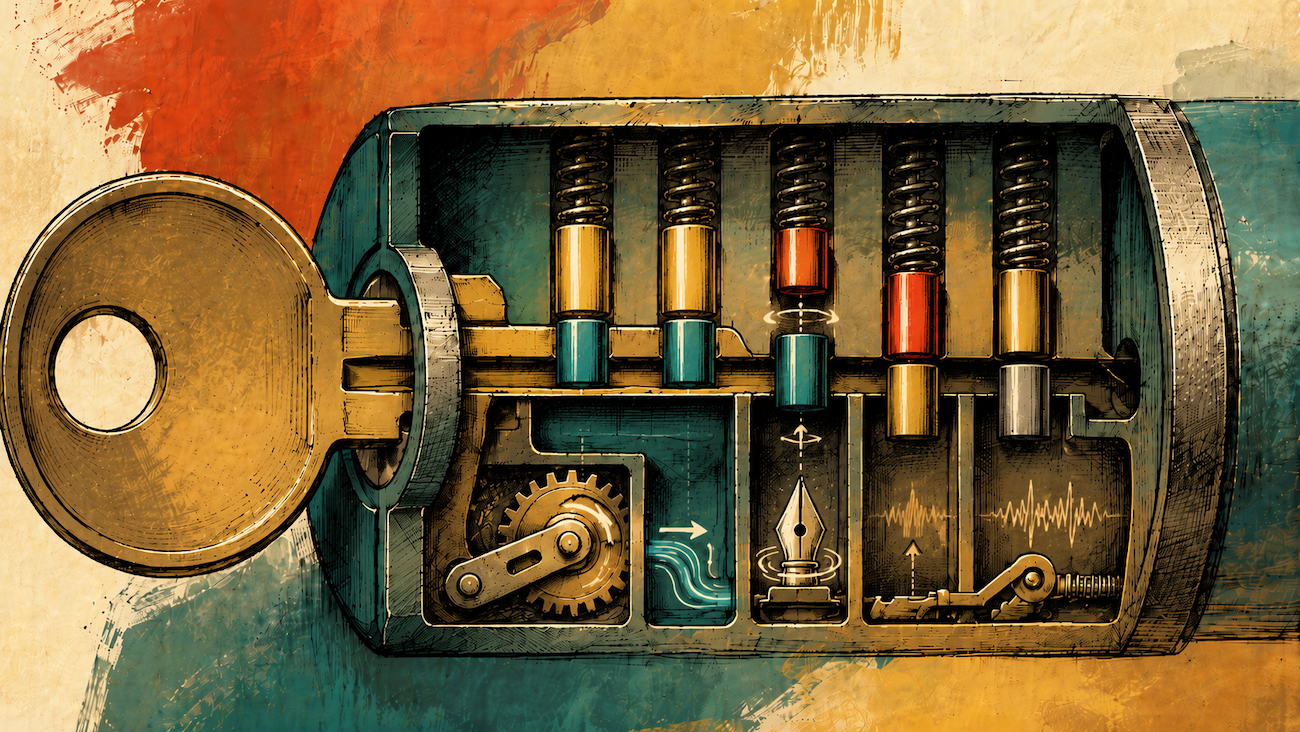
Picking the lock
A lock contains several pins that need to move into alignment before it opens. Moving one does not solve the whole mechanism, but it gives you access to the next part. Discovering where we function best may work in much the same way.
You resolve one point of resistance and gain new information. Perhaps you develop a skill, enter a different environment or discover that you are better at something than expected. Perhaps you learn that you love one part of the work and cannot stand another. Either way, you now possess information that was not available before, and that information exposes the next point of resistance.
Over time, a combination begins to emerge that would have been impossible to predict at the start. The lock also changes as we do. Work that fitted at 25 may feel completely wrong at 40. That does not make the earlier decision a mistake. Sometimes a role is not your destination; it is simply where you collect several of the tools you will need later.
This is where some career advice becomes unnecessarily dramatic. Every job does not need to be your calling, and every career decision does not need to survive until retirement to have been worthwhile. A chapter can be valuable without becoming the whole book.
When poor fit starts to feel like personal failure
I spent roughly fifteen years working in marketing. During that time, I developed useful abilities in strategy, storytelling, data, communication, leadership and understanding how different parts of a business affect one another. None of that was wasted. I still use all of it.
But those abilities did not always operate together in a way that felt natural. For a long time, I assumed the problem was me. Perhaps I lacked drive. Perhaps I needed more discipline. Perhaps I was ungrateful for opportunities other people would have been delighted to receive. Everyone else seemed to be progressing and participating in meetings without privately investigating whether the air-conditioning ducts offered a viable escape route.
When work repeatedly feels harder than it appears to be for everyone else, it is easy to turn that difficulty into a character judgement. You decide that you are lazy, inconsistent or incapable of settling down, then work even harder to tolerate an environment that asks you to operate against your natural wiring.
The dangerous part is that increased effort can produce just enough success to keep the arrangement going. You perform, so nobody – including you – questions what it is costing. Your ability to endure the work becomes the evidence that you should continue doing it.
Looking back, many of the individual abilities were already present. What was missing was a better way of combining them. Marketing developed the component parts. My reinvention work gave them a different subject. Antistable tested whether I could turn the thinking into a system. Speaking tested whether I could make those ideas useful to other people. Workshops and AI projects are now testing where the combination creates practical and commercial value.
None of this followed a master plan. Each stage gave me enough information to attempt the next one. For years, I thought I needed to become better at fitting the work. It took me an embarrassingly long time to consider that perhaps I needed to build work that made better use of me.
More effort is not always the answer
One of the ideas from Dan Heath’s Reset that has stuck with me is that progress depends on finding the real constraint rather than throwing more effort at the whole system.
His doughnut shop example is simple. If customers are waiting because the shop cannot take orders quickly enough, installing a faster fryer does not solve the problem. It produces doughnuts faster while the queue continues stretching into the car park.
This is also how many of us approach ourselves. We feel stuck, so we work harder. We improve our routine, download another productivity app and purchase a notebook whose paper quality implies that this time our entire life will finally come together.
But more effort only helps when insufficient effort is the actual constraint. The problem might be a missing skill, fear, depleted energy, financial pressure, the wrong environment or an identity we are protecting long after it stopped being useful. Sometimes working harder simply helps us survive inside the wrong system for longer.
The point of greatest resistance matters not because the hardest thing is automatically right, but because it gives us information. Otherwise, we risk treating every locked door as a character-building opportunity and spending six months headbutting the broom cupboard because persistence is apparently a virtue.
Fear may be holding us back from something that matters. A capability gap may mean the direction is right but we are not ready. Low capacity may mean the experiment is sensible but the timing is not. Money, health, family responsibilities or access may limit what is possible. Sometimes we are protecting an identity that once gave us safety or approval. Sometimes the work is simply wrong.
Those situations require different responses. Fear may need a small act of courage. A missing capability needs learning. Low capacity needs recovery or a smaller experiment. Structural limits require support or redesign. An outdated identity requires honesty. Genuine misfit requires us to stop treating endurance as a virtue.
Before fighting resistance, it is worth asking what it is trying to protect. Some beliefs helped us create security, belong somewhere or become the person other people needed us to be. They were not necessarily foolish; they may simply have remained in place after the circumstances that created them changed.
Changing direction does not make the years before it a waste. It may simply mean the previous chapter has finished teaching us what it could.
Action creates evidence
James Clear’s work on identity-based habits distinguishes between changing outcomes, changing processes and changing the beliefs we hold about ourselves. That identity layer matters because it is difficult to believe something new when we have no evidence for it.
We often assume that we need to decide who we are before we act. In reality, action can be what makes a new identity believable. You do something, discover that you are capable of it, repeat it and find that someone else values it. Gradually, a part of you that existed only as a vague possibility begins to feel real.
Experimentation allows reality to participate in the decision. It also stops us announcing a new identity before reality has had any opportunity to comment. There is a meaningful difference between interviewing one interesting person to see whether you enjoy it and spending R20,000 on recording equipment because you have decided you are now a podcaster.
Some experiments will work. Others will leave the people closest to you wondering whether this is professional reinvention or the opening stage of a breakdown involving a microphone and several colour-coded Post-it notes. The point is not for every experiment to succeed. It is for each experiment to make the next decision better informed.
A workshop may fail to become a viable product but reveal that you love facilitating. A project may show that you enjoy designing the system but hate maintaining it. A talk may demonstrate that the idea is useful while exposing that nobody wants to pay for the product attached to it. The stated outcome can fail while the information succeeds.
Failure, however, is not automatically useful. Random activity is not experimentation, and repeatedly doing strange things without learning anything from them is simply chaos with optimistic branding.
Start smaller than your ambition wants you to
Instead of asking, “What is my purpose?”, ask: What is currently preventing me from learning more about where I fit?
Identify whether the resistance is fear, missing capability, depleted capacity, an external restriction, attachment to an old identity or genuine mismatch. Then design the smallest real experiment that can teach you something. Facilitate one session. Help one person solve a problem. Build a crude version. Volunteer for a different task. Publish something. Take on one small client.
The experiment should be small enough to attempt, but real enough to produce evidence. Ideally, it should involve another person, an actual output or some form of feedback. Imagining yourself doing something is not the same as doing it. I have imagined myself being excellent at many things that reality has since had the decency to correct.
Afterward, ask whether the work gave you energy or consistently drained it. Did you show ability or improve faster than expected? Did it create value for someone else? Did you want to do it again? Could it fit into the life you genuinely have rather than the imaginary one where you require no sleep and nobody ever asks anything of you?
Then ask the less comfortable question: what difficulties came with the work, and are you prepared to tolerate them? The right function will not make everything easy. It will still contain admin, uncertainty, rejection and people who schedule meetings that could have been emails. The point is not to find work without problems. It is to find problems that feel worth solving.
Finally, identify what the experiment revealed and what should be tested next. The loop is simple: resistance, diagnosis, experiment, evidence, repeat. You do not need the full answer. You need the next useful piece of information.
A better use of ourselves
I still believe there may be a particularly effective use of each of us, regardless of the chapter we are in. But I no longer believe it arrives fully formed, or that there is only one possible answer. We remove one constraint, test what becomes possible, keep the evidence and let go of what no longer fits.
Eventually, we may find ourselves doing work that makes unusually good use of abilities we had carried for years without understanding how they belonged together.
By the time I finished explaining this to Vally, she had largely stopped responding. The Fat Vandal was still purring. I had not uncovered one permanent answer to what I was designed to do, but looking back at how one experiment had led to another, I could finally see the shape of it.
Fit had not been waiting somewhere for me to find it. I had been building it all along.

Systems Thinking in Business: Is Your Purpose the One on the Wall?
Systems thinking in business shows how elements, interconnections and purpose reveal what an organisation is really built to do.
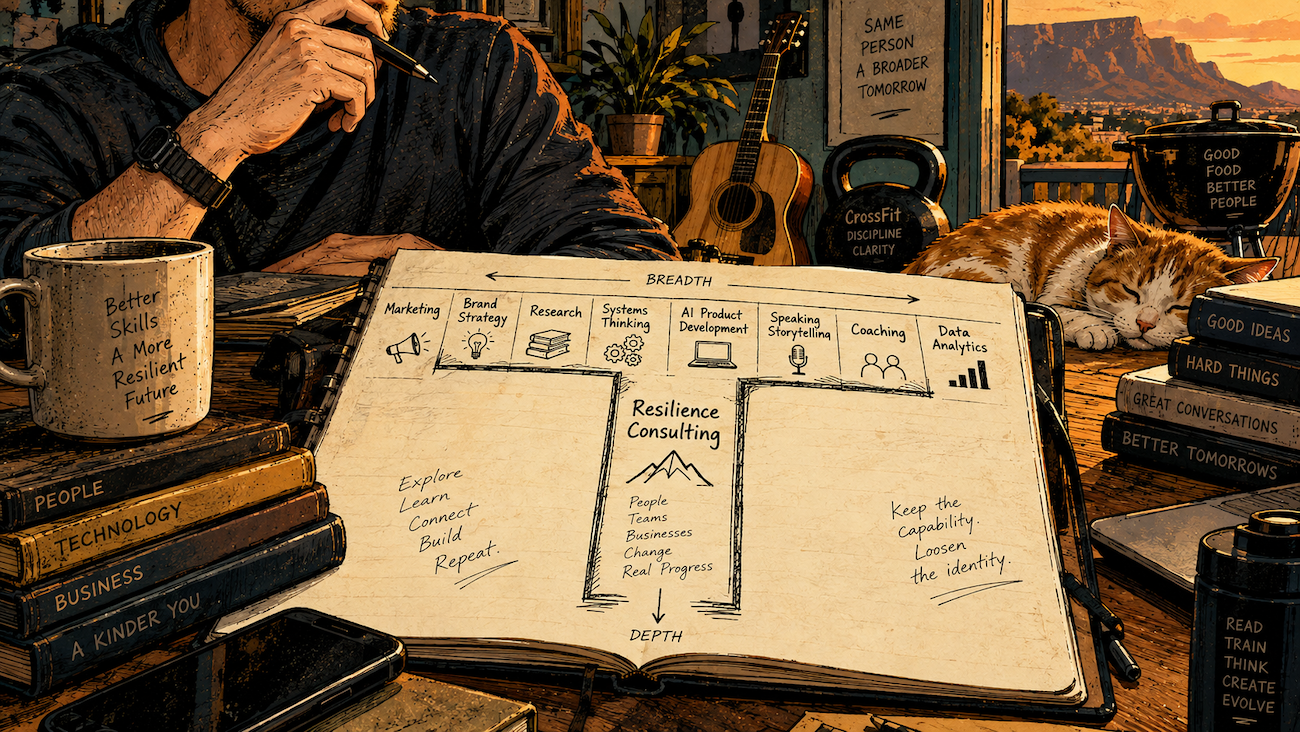
T-Shaped Skills: How to Build Career Resilience Before You Need It
Build career resilience with T-shaped skills: keep your deep expertise, broaden your capabilities, and learn how to explore and[…]

Employee Resilience: Why Purpose Matters to Business Resilience
How does employee resilience strengthen a business? Explore the role of purpose, alignment and individual capability under pressure.
2 Responses
[…] of the reasons I kept choosing it. I’ve written previously about that longer journey of trying to find work that actually fits you. Looking back, this was another part of the same […]
[…] wanted the future that came with it. I’ve written more about that process of trying to find work that actually fits you, but at the time most of my professional history was pointing me towards exactly the thing I no […]