
That dashboard light you’ve been ignoring for the past three weeks – the one you’ve convinced yourself is probably nothing? Maintenance matters, especially when it comes to organisational resilience, because most systems don’t fail suddenly – they wear out quietly.
On your car. On your body. On anything you expect to last longer than a week and not embarrass you in public. When that random, indistinguishable warning light pops up on your dashboard, it’s not there for decoration. It’s a signal. Something isn’t right. The same thing happens when your knee starts doing that weird clicking thing every time you stand up. One day you’re fine. The next you sound like a microwave finishing its cycle every time you move.
I’ve ignored those signals more times than I’d like to admit, and once I left it so long that when I finally stopped to look, every warning light was on (my “Bohlingers Moment”). We don’t fix these things because we enjoy it – nobody wakes up thinking, “Today feels like a fantastic day to spend money on problems I’ve been actively ignoring.” We fix them because we know how this ends. The interesting part is, this isn’t just about cars or knees. It shows up everywhere. Ignore the light long enough and you’ve made a decision. Not consciously, but a decision nonetheless. You’ve decided you’re comfortable with the consequence, right up until you’re broken down in the pouring rain somewhere between nowhere and regret.
Our bodies are no different. Flimsy, frustrating pieces of meat at the best of times, held together by systems that are constantly working to keep everything functioning. When something starts hurting, it’s rarely isolated. A shoulder issue becomes a back issue, a knee issue becomes a hip issue, and the surrounding muscles start compensating, quietly taking on more load than they should. That’s the problem. Compensation feels like it’s working right up until it spectacularly isn’t.
Systems, signals and the cost of ignoring both
I love a system, it’s a set of interconnected parts that produce an outcome, whether you realise it or not. In your life, your work, relationships, health, hobbies and downtime aren’t isolated. They’re linked. They balance each other out, compensate for each other and, when under strain, start to break each other. This is system thinking in business, whether you acknowledge it or not.
And when one part of the system fails, it doesn’t stay contained. A cancelled holiday doesn’t just ruin a few days off; it spills into your mood, your energy, your work and your relationships. One disruption quietly ripples through everything else.
Nature has already solved most of these problems. The human body is one of the most sophisticated systems we have access to. It constantly monitors itself, adapts, compensates and, when something goes wrong, sends signals – not to annoy you, but to keep you alive. It’s the same pattern, just in different places. Signals get ignored, systems compensate and eventually something breaks. So why don’t we apply the same thinking to the systems we build in business?
Because businesses, at their core, are no different. They are living systems made up of interconnected parts, constantly under pressure and constantly adapting. This is where organisational health metrics become critical, because without them, you are effectively guessing. And just like the body compensates, parts of the business quietly pick up load when something else isn’t working. The difference is, we tend to ignore the signals for far longer.
Performance is easy to measure. System health isn’t.
We’ve decided that financial performance is the primary measure of success. And to be fair, it matters. A lot. Businesses need to make money, otherwise they’re just very expensive hobbies with a logo. But as a primary measure, it’s short-sighted. Financials tell you what has already happened. They tell you how fast the car is going. They tell you nothing about whether the engine is about to fall out somewhere on the N1.
They don’t tell you what strain the system is under, which team is compensating for another or how close you are to something breaking. They tell you the output, but they don’t tell you whether that output is sustainable. The question isn’t whether you’re performing, it’s whether that performance is sustainable. This is the gap in most organisational performance measurement approaches. They focus on outcomes, not on the underlying system capacity that enables those outcomes.
I default to Formula 1 analogies far too often, but it’s because they’re useful. At that level, performance isn’t just about going fast. It’s about how long you can sustain that speed without turning your engine into a very expensive paperweight. Every component is measured – temperatures, pressures, degradation and fatigue – not because it’s interesting, but because the margin for error is microscopic. The car isn’t just built for speed; it’s built within tolerance. Push it too hard, too long, in the wrong conditions and you’re not finishing the race.
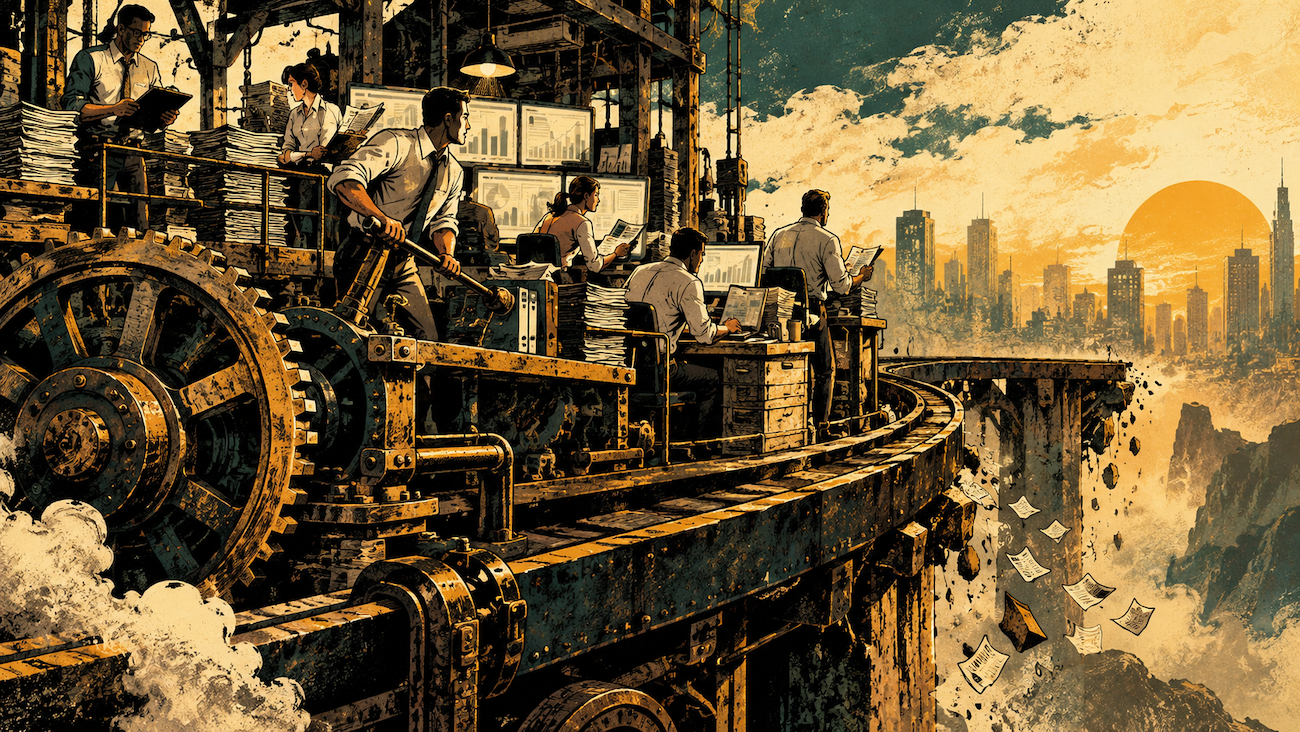
When one part of the system comes under strain, something else compensates, and if that strain isn’t managed it spreads. They don’t wait for failure to understand the system. They measure it continuously so they can adjust before failure happens. In most businesses, we do the opposite. We optimise for output – faster, more, better – without really understanding the cost that’s being absorbed underneath the surface to make that possible.
For a while, it works. It often works really well, until the compensation layers stack up to the point where something breaks. When it does, it never looks like a small problem. It looks like burnout, attrition, cultural breakdown, strategy that suddenly stops landing and performance that drops without an obvious reason.
It looks like a surprise. It isn’t. It’s accumulated strain that was never measured.
Measuring what actually matters
Businesses don’t fail because they don’t perform. They fail because they don’t maintain the system that enables performance. If we want to build organisational resilience strategies that actually work, we need to get better at looking under the hood.
Not just at the output, but at the system, the strain and the signals that are easy to ignore when things still appear to be working. By the time the warning light becomes a breakdown, it’s already been too late for a while. We know this. We see it happen all the time, and yet we still don’t deal with it early.
The frustrating part is that this isn’t new territory. We already know how to do this:
- Anticipate change: recognise that stability is temporary and pay attention to the signals before they become problems
- Design for change: build systems and behaviours that can absorb pressure
- Implement for change: ensure the system actually evolves under pressure
- Measure everything: because resilience in the workplace depends on what you can see, not what you assume
The moment you start measuring what’s happening inside the system, you start to build something far more useful than a set of financial reports. You start to build an organisational service book.
Something that tells you what’s been maintained, what’s under strain and what needs attention before it fails. Because the moment you can see the system clearly, you stop guessing—and start making better decisions.
Just like your car or your body, the goal isn’t to see how hard you can push it. It’s to see how long it can last while still performing at its best.
The question then becomes what lights are flashing on your organisation’s dashboard right now. And if the answer is none, it’s worth asking a different question: do you actually have the right measurements in place?
Because the reality is that in any system under pressure, something is always lighting up. If you’re not seeing it, it’s not because everything is fine. It’s because it’s not being measured – or nobody’s looking.

The Resilience to Redefine Victory: Solveig Løvseth at IRONMAN Kona
Solveig Løvseth’s remarkable IRONMAN Kona finish reveals how resilience can mean changing course, recognising our limits and redefining victory.

Leadership Blind Spots: Would You Know If Pressure Changed the Way You Lead?
Leadership blind spots can grow under pressure. Learn how changing behaviour weakens feedback and leaves leaders unaware of their
Business Resilience: When People Stop Challenging How Work Gets Done
Business resilience can weaken while performance still looks fine. One early warning sign is when people stop challenging how[…]
One response
[…] resilient response requires the business to acknowledge the failure, remove as much of the customer’s remaining effort and cost as possible, restore their sense of […]