There’s a particular kind of tired that doesn’t look like burnout.
Everything is still functioning. Work is getting done. Meetings are happening. Progress is, technically, being made. But underneath it all, there’s a low, constant sense of fatigue. The kind where your brain still works, just in shorter, slightly more sarcastic bursts.
Deadlines, meetings, plans, replans, and those “quick catch-ups” that somehow require both a calendar invite and the emotional energy of preparing for a minor court appearance.
It’s not dramatic enough to fix. But it’s not nothing either. And that got me thinking. Not about how to fix tired, but about the different types of tired. Which sent me down a bit of a rabbit hole that started with “maybe I just need more sleep” and ended somewhere far more uncomfortable: effort versus meaning.
What I didn’t expect to find was that there are actually a few very predictable states we move between depending on how much effort we’re putting in and whether that effort feels like it means anything. It’s a simple model, but it explains almost every version of “tired” we experience at work.
What this led to is something I’ve started to think of as the Resilience Engine – a simple way to understand why some work drains you while other work sustains you, and ultimately how we build resilience at work in a way that actually lasts.
Why Work Feels Harder Than It Should
We tend to treat tired as something that needs solving. Take a break, reduce workload, push through, optimise your calendar, drink more water, buy a better water bottle that promises to fix your life through hydration and mild shame. But tired isn’t the problem. It’s the signal. Because not all tired is created equal.
You can finish a long day feeling completely exhausted and still think, “that was worth it.” Or you can feel exactly the same level of exhaustion and think, “I cannot do this again tomorrow without becoming a different person.” The energy output is identical, but the experience is completely different.
You know that feeling when you’ve been busy all day, exhausted by 6pm, and you still can’t explain what actually moved forward? You’ve replied to emails, sat in meetings, updated documents, moved things from one column in a spreadsheet to another, and yet if someone asked you what actually changed, you’d pause… and then confidently say something vague like “alignment” while hoping no one asks a follow-up question. That’s not a time problem. That’s a meaning problem.
Resilience doesn’t break because of effort. It breaks when effort stops connecting to meaning.
At its simplest, effort is the amount of energy you’re putting in, and meaning is the degree to which that energy feels like it actually matters. Everything else – motivation, burnout, resilience, and sustainable performance – sits somewhere on top of that relationship. Meaning isn’t always objective either; it’s perceived, and that perception shapes how effort is experienced.
Meaning comes from three things: clarity, impact, and ownership. Do I understand what I’m doing, can I see what it’s changing, and do I feel connected to the outcome? Remove any one of those and work starts to feel like you’re assembling IKEA furniture without instructions, tools, or any real understanding of what you’re trying to build.
When you map effort against meaning properly, a pattern starts to emerge.
The Resilience Engine: Effort, Meaning and Performance
| High Meaning | Low Meaning | |
|---|---|---|
| High Effort | Aligned Intensity | Burnout Zone |
| Low Effort | Underutilised Potential | Apathy / Drift |
Stripped back like this, the model is simple enough to recognise instantly, but rich enough to explain almost every version of “tired” we experience at work.
Aligned Intensity is where effort compounds because it is connected to something clear and valuable. Progress is visible, momentum builds, and while energy is spent, it is also replenished. This is the kind of tired people come back to, the kind where you’re exhausted but oddly upbeat, like you’ve just run a marathon for a good reason rather than sprinted in circles because someone shouted “urgency.”
The Burnout Zone is where effort continues, but meaning quietly exits through the back door. Work becomes reactive, misaligned, or repetitive, and energy drains faster than it can recover. This is not just emotional; it is measurable. Gallup estimates that global disengagement costs the economy $8.8 trillion annually, which is an extraordinary amount of money to spend on people doing things that don’t feel like they matter.
Underutilised Potential is where meaning exists, but effort never quite rises to meet it. People care, but they are not stretched, not challenged, and not fully engaged. Over time, that gap creates frustration, like owning a high-performance car that you’re only allowed to drive in a school parking lot at 20 km/h.
Apathy or Drift is where both effort and meaning are low. Nothing feels broken enough to fix, but nothing meaningful is progressing either. Work continues, meetings happen, and updates are given with great confidence about very little. It’s not failure in the dramatic sense. It’s slow, quiet, administrative decay.
Now, if you take that exact same model and look at it through the lens of workplace resilience, the pattern becomes much harder to ignore.
How the Resilience Engine Behaves in the Workplace
| High Meaning | Low Meaning | |
|---|---|---|
| High Effort | Resilience Regenerates | Resilience Drains |
| Low Effort | Resilience Stagnates | Resilience Becomes Irrelevant |
In high effort, high meaning environments, resilience regenerates. The energy you put in comes back to you because it is connected to something that matters, which is why people can sustain this state far longer than they should logically be able to.
In high effort, low meaning environments, resilience drains exponentially. The system keeps demanding energy without returning it, which is why burnout is not caused by too much work, but by work that doesn’t feel like it matters.
In low effort, high meaning environments, resilience stagnates. People care, but without sufficient challenge, there is no activation of growth. Energy builds, but has nowhere to go, which is how good people slowly become disengaged.
In low effort, low meaning environments, resilience becomes irrelevant. There is no demand placed on the system and no reason for it to respond. Work continues, but nothing compounds, and over time the whole thing just… settles.
This is not just a personal insight. It is structural.
Right now, a lot of organisations are not short on effort. If anything, they are saturated with it. There are more tools, more systems, more dashboards, and more layers of optimisation than we have ever had before. AI has arrived and, on paper, everything should be getting easier. Yet most organisations are still not seeing meaningful impact.
Recent research from McKinsey shows that while 78% of organisations are using AI and 71% are using generative AI regularly, the majority are not seeing significant enterprise-level value. The single biggest driver of impact is not the technology itself, but the redesign of workflows – changing how effort connects to meaningful outcomes.
Which means most organisations did not reduce effort.vThey simply accelerated it.
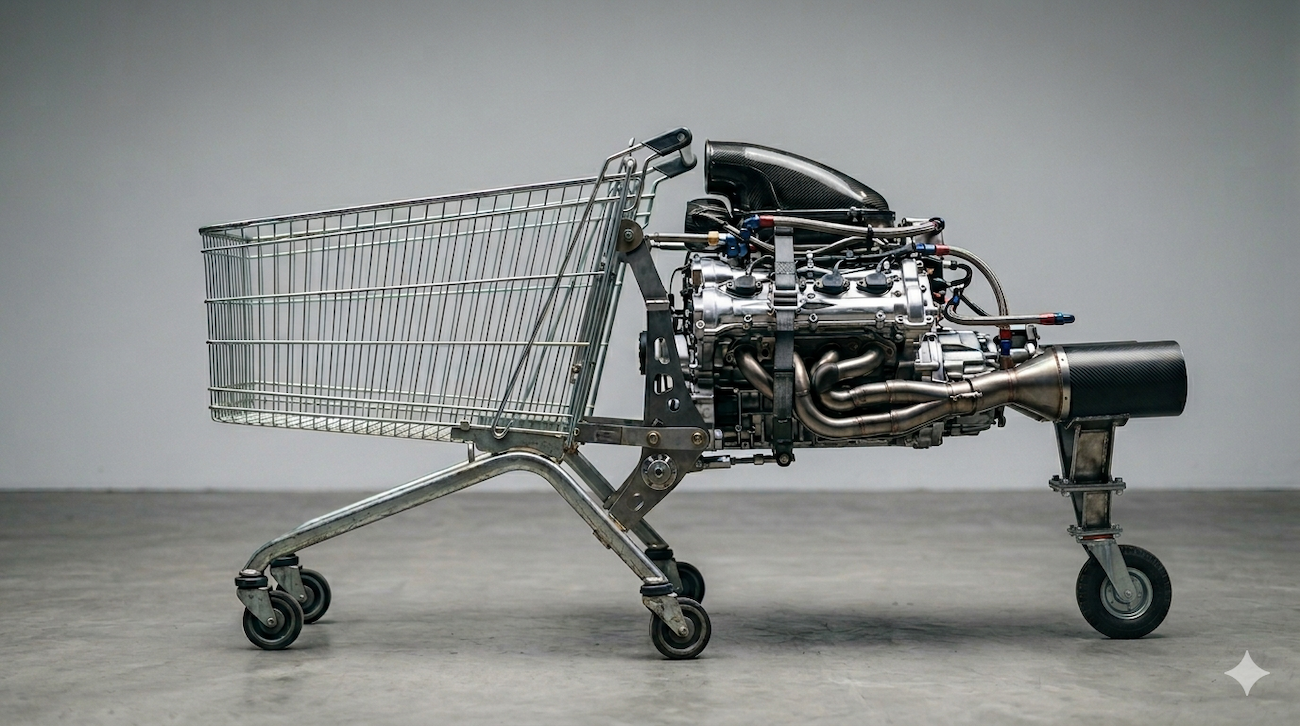
It’s like taking a Formula 1 engine and bolting it onto a shopping trolley. You’ve added power, speed, and capability, but you haven’t changed the structure. It’s still unstable, still directionless, and now just far more efficient at going nowhere, faster.
That’s what a lot of organisations have done. They’ve taken systems that were already misaligned, layered in more tools, more automation, more AI, and turned them into high-performance versions of the same chaos.
And if large groups of capable people are consistently exhausted in the same way, it’s not a capability issue. It’s a design issue.
So the question shifts. Not how do we make people less tired, but what kind of tired are we choosing?
Because effort is not optional. That is part of the deal. But whether that effort connects to something meaningful absolutely is, even if not all of that alignment is immediately within our control.
Some of this is structural. But some of it is also choice. We stay in work that no longer connects to meaning because changing it would require harder conversations, clearer decisions, or stepping into uncertainty. And the longer we stay in that misalignment, the more normal it feels, which is what makes it so dangerous.
For individuals, that might mean asking whether the work you are doing actually moves something that matters. For leaders, it becomes more uncomfortable. Where are we creating effort without meaning? Where are we adding layers instead of removing friction? What work are we still doing that no longer needs to exist?
What this model shows – what the Resilience Engine makes visible – is that resilience is not about capacity, it’s about alignment. Resilience is not built by asking people to push harder. It is built by designing systems where effort counts.
If you want to take this a step further, this is exactly what the Titanic Diagnostic is designed to surface. It gives you a view of where you are operating, both as an individual and as an organisation, across how you anticipate, design, and implement change. Because once you can see the pattern, you can start to shift it.
And if this feels familiar, it’s probably not just you. Most teams are sitting somewhere on this model without ever naming it, which is usually where the real problems start.
No responses yet