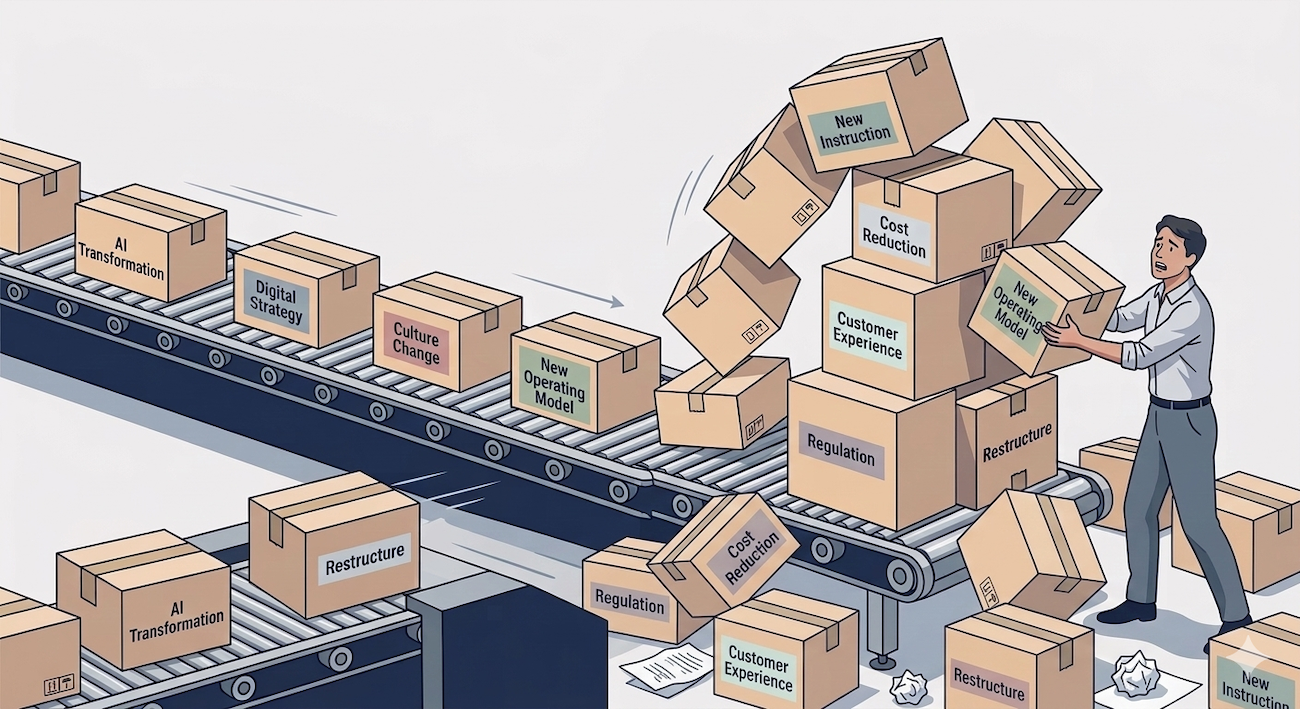
Roughly 70% of change management initiatives fail. The change management failure rate has hovered at that level for decades. At that point, the problem is not execution. It is structural.
Change management was built for stability interrupted by occasional disruption. A merger. A restructure. A system rollout. You assembled a task force, created a detailed implementation plan, ran communication cascades, managed resistance, and returned to business as usual. The entire discipline assumed periods of calm between waves of change.
That assumption no longer holds.
Change is no longer episodic; it is embedded in the operating environment. Artificial intelligence reshapes workflows overnight. Regulation evolves. Markets compress. Talent moves. Customer expectations accelerate. Before one initiative has landed, the next is already in motion. Organisations are not navigating isolated events; they are operating inside continuous disruption.
And you cannot manage a condition with a project plan.
If you want a deeper look at how organisations repeatedly misdiagnose systemic problems as project failures, I unpack that further in Designing for Change, where we explore why most transformation efforts treat symptoms rather than structures.
This is why change management continues to disappoint. Not because leaders lack intent. Not because HR lacks effort. And not because employees are inherently resistant to change. Change management fails because it was designed for intermittent disruption, while modern organisations face increased uncertainty as a constant.
In this environment, the real constraint is adaptive capacity in business. Most change management programmes quietly assume there is spare bandwidth in the system – that teams can absorb new initiatives without degrading performance. There isn’t. Every new transformation competes with existing workload, legacy processes, reporting structures, performance targets, and cognitive fatigue. When change exceeds adaptive capacity, performance does not improve; it declines.
You see it operationally in:
- Declining decision quality
- Slower execution cycles
- Rising error rates
- Engagement fatigue
- Attrition reframed as opportunity
This is not resistance. It is systems overload. It is what happens when you continue installing software updates without upgrading the hardware.
Executive teams increase the frequency and scale of change management initiatives while HR and people functions are asked to drive engagement and adoption. Very few organisations measure whether the system can actually absorb the load. Strategy sets the pace. People functions manage the fallout. Neither owns adaptive capacity. As a result, change accelerates into systems that cannot metabolise it.
We keep demanding high performance from systems we have never invested in upgrading.
The failure points are predictable. Change management collapses when direction lacks clarity, when motivation erodes, or when environmental friction remains intact. If people are unclear about what behaviour must actually change, they default to familiar habits. If the primary beneficiary of change appears to be shareholder optics rather than customer value or team wellbeing, enthusiasm declines. If systems, incentives, and workload structures remain untouched, behaviour reverts.
People do not follow slide decks; they follow energy, safety, and the path of least resistance. This is why psychological safety becomes foundational to organisational resilience. When safety drops, learning drops – and when learning drops, adaptive capacity shrinks. I explored that dynamic more fully in Psychological Safety – The Difference Between Performance and Panic.
There is also a motivational constraint. Continuous disruption consumes not only financial resources but organisational will. In The Infinite Game, Simon Sinek distinguishes between finite and infinite mindsets. Finite leadership optimises for short-term wins and shareholder outcomes; infinite leadership advances a longer-term cause and builds organisations designed to endure.
Employees can tell who benefits from change.
When benefit flows upstream to shareholders, quarterly optics, and cost targets, change feels extractive. When benefit flows downstream toward customers and the people doing the work, it feels purposeful. Continuous disruption runs on two currencies: resources and will. Most organisations measure the first obsessively and assume the second will regenerate itself. It will not. When will declines, friction increases, and no amount of structured change management compensates for a motivational deficit.
This is where the shift from change management to organisational resilience becomes essential.
Change management attempts to move an organisation through change. Organisational resilience builds the adaptive capacity required to operate inside increased uncertainty. Trained resilience is the deliberate development of adaptive capacity before disruption demands it. It is not a quarterly initiative; it is an organisational resilience strategy.
Building resilience in organisations requires strengthening the internal operating system – behavioural norms, psychological safety, decision processes, structural design – so that when complexity rises, performance does not collapse. Change management assumes stability between disruption. Organisational resilience assumes instability is permanent. One reacts to change. The other prepares for it.
In Scaling Leadership, the authors describe the challenge clearly: “We are running an internal operating system that is not complex enough for the complexity we face. This is our development gap.” In most organisations, that development gap is widening. Complexity accelerates, expectations increase, change management initiatives multiply – yet the internal operating system remains largely untouched.
This is the Resilience Gap: the widening distance between the complexity being demanded and the adaptive capacity available to absorb it. When ambition outpaces capacity, friction wins. Until organisational resilience becomes infrastructure rather than initiative – until adaptive capacity is built before acceleration – the change management failure rate will remain exactly where it is. Each new transformation will quietly make the next one harder than the last.
If you want to understand how your organisation is currently faring – whether you are strengthening adaptive capacity or simply layering change management on top of fatigue – start with the Titanic Diagnostic and find out.
No responses yet