Pressure has a way of revealing the true strength of a system. Markets shift, competitors appear, regulation changes, or an unexpected crisis suddenly places strain on an organisation that seemed stable the day before. In those moments leaders often ask the same question: how do we become more resilient – or more specifically, how do we build resilience in a way that actually lasts?
This is where most discussions about how to build resilience go wrong. The focus is often on reacting to pressure in the moment, rather than understanding how resilience is developed over time. The uncomfortable reality is that resilience is not something that can be quickly created once pressure arrives. When disruption hits, individuals and organisations do not suddenly develop resilience. What actually happens is much simpler: the pressure reveals the resilience that already exists inside the system.
If there is one idea worth holding onto, it is this: resilience is not built in the crisis – it is revealed by it.
It is built long before the crisis arrives.
When a major shock hits a business – whether that is regulatory change, technological disruption, or an unexpected market shift – the response is determined by what already exists inside the system. Leaders respond with the clarity they have built, teams respond with the trust they have developed, and the organisation responds with the operational strength it has created over time. The crisis does not create resilience. It reveals it.
To understand how to build resilience, it helps to recognise that it operates in two distinct but connected ways:
- Short-term resilience determines how much pressure can be absorbed today
- Long-term resilience determines how much pressure the system will be able to handle in the future
The Battery: Why Resilience Runs Out
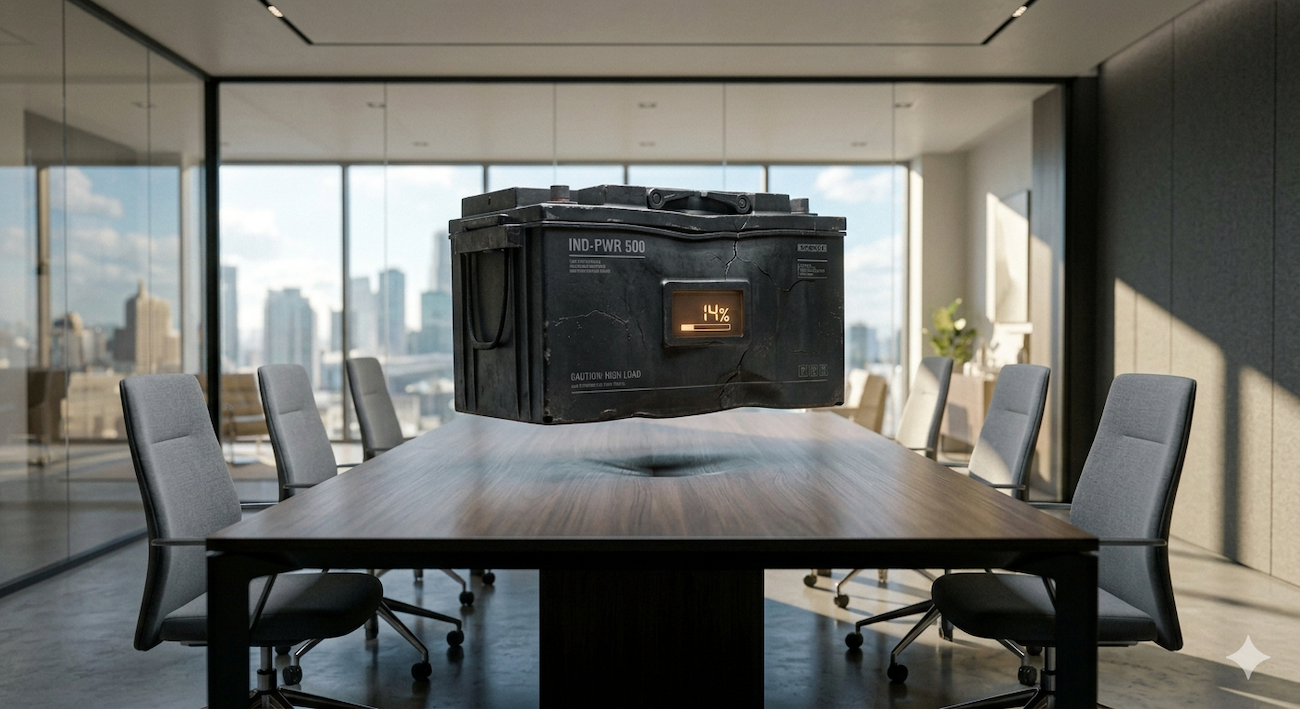
Short-term resilience can be thought of as the battery that powers a system. It represents the amount of pressure, stress and responsibility that can be carried before performance begins to deteriorate. You can operate at high intensity for a period of time, sometimes even feeling productive, until suddenly you feel like a laptop running on two percent battery, three open tabs, seventeen unfinished thoughts, and a faint but growing desire to move to a remote island and raise goats.
This is the part of resilience that must be actively managed, because it is constantly being drained by factors that often accumulate quietly:
- sleep debt
- decision fatigue
- emotional conflict
- constant context switching
- lack of control
- uncertainty
- poor health
These pressures don’t just affect individuals. They show up inside organisations in remarkably similar ways.
What drains resilience in people and organisations
| In people it looks like… | In business it looks like… | Resilient organisations counter it by… |
|---|---|---|
| Sleep debt | Operating permanently at peak capacity with no slack | Building recovery space into planning cycles |
| Decision fatigue | Leadership overwhelmed by constant decisions | Establishing decision frameworks and distributing authority |
| Emotional conflict | Internal politics and unresolved tension | Creating psychological safety and resolving conflict early |
| Constant context switching | Rapidly shifting priorities | Maintaining strategic clarity and reducing unnecessary pivots |
| Lack of control | Low autonomy | Giving teams ownership over outcomes |
| Uncertainty | Mixed signals and unclear direction | Communicating clear intent |
| Poor health | Fragile systems and under-resourced teams | Investing in strong operational foundations |
When the battery runs empty, the outcomes are predictable.
When the battery is empty
| In people it looks like… | In organisations it looks like… |
|---|---|
| Burnout | Disengagement and rising turnover |
| Anxiety spikes | Reactive leadership behaviour |
| Poor decisions | Short-term thinking and firefighting |
| Short tempers | Blame cultures and friction |
| Avoidance | Delayed decisions and stalled execution |
Burnout rarely arrives dramatically. Days begin to blur together, motivation fades, and things that once felt energising become difficult to engage with. At some point you find yourself staring at your screen, rereading the same sentence for the fourth time, while your brain quietly powers down like an old Nokia entering retirement.
Eventually the system stops.
A Simple Way to Think About Resilience
At its simplest, resilience can be understood as an equation:
Resilience = Battery + Capacity + Design
- Battery is how much pressure you can handle today
- Capacity is how much pressure you can handle over time
- Design is how your system is structured to absorb that pressure
Short-term resilience is your battery. Long-term resilience is your capacity. But the factor that determines whether either of those improve is design. Battery can be managed. Capacity can be built. But design determines whether either of those are sustainable.
Capacity: Why Some Systems Carry More
While the battery drains daily, the capacity of the battery itself can grow over time. Resilience capacity behaves much like physical strength. It develops gradually through cycles of stress, recovery and adaptation. No one becomes strong in a single moment, despite what every January gym membership might suggest. Resilience works in exactly the same way.
Across psychology, neuroscience and performance research, consistent patterns emerge in people who demonstrate high resilience and organisations that perform well under pressure.
| For individuals resilience grows through… | For organisations resilience grows through… |
|---|---|
| Sleep | Clarity |
| Health | Alignment |
| Relationships | Capability |
| Purpose | Trust |
| Emotional regulation | Leadership maturity |
| Meaningful progress | Operational design |
The details differ, but the structure is the same. Resilient systems are built on stability, support and capability – not bursts of heroic effort.
The difference between resilient and fragile systems is not how they react under pressure. It is how they were designed before the pressure arrived.
How Resilience Capacity Is Built Over Time
This is where resilience stops being a concept and becomes a design problem.
For both individuals and organisations, learning how to build resilience over time is less about intensity and more about consistency – the repeated creation of conditions that allow systems to recover, adapt and grow stronger.
Resilience grows when systems:
- allow for recovery
- distribute pressure effectively
- build capability through repeated cycles of challenge and adaptation
When those conditions exist, capacity expands. When they do not, resilience gradually erodes. Most of the time, this erosion happens quietly while everything still appears to be functioning normally. Work gets delivered, decisions get made, and performance appears stable.
Everything looks fine, right up until it very clearly isn’t.
And when these systems are not designed deliberately, the consequences do not appear immediately – they appear gradually.
Early Signals: When Capacity Is Being Exceeded
When pressure begins to exceed capacity, early signals start to appear. These are often interpreted as isolated issues rather than indicators of a broader structural pattern.
| What leaders notice | What it may signal underneath | Constructive response |
|---|---|---|
| Sudden staff turnover | Sustained pressure over time | Rebalance workload and restore slack |
| Burnout and sick leave | Breakdown in recovery cycles | Reinforce sustainable rhythms |
| Constant firefighting | Systems not designed for volatility | Improve planning and decision frameworks |
| Strategic drift | Leadership consumed by reaction | Re-establish clarity and priorities |
| Cultural tension | Pressure unevenly distributed | Strengthen communication and trust |
Many of the challenges associated with burnout at work and declining performance are not caused by a lack of effort, but by systems that are quietly operating beyond their sustainable limits. These are not failures. They are signals.
The Efficiency Trap: When Optimisation Creates Fragility
Many organisations are highly optimised for efficiency. Efficiency improves speed, reduces waste and enhances performance. However, it also pushes systems closer to their limits. When everything is fully utilised and tightly managed, there is little room left for recovery, experimentation or unexpected disruption.
In stable environments this works extremely well. In volatile environments it creates fragility.
It is the organisational equivalent of driving a Formula 1 car permanently in the red zone and being surprised when something eventually explodes.
Without slack, even small disruptions begin to cascade. Teams become reactive, priorities shift constantly, and the organisation gradually moves into a permanent state of firefighting. This is why organisational resilience cannot be built through isolated initiatives. It requires deliberate design across how work is structured, how decisions are made and how pressure is distributed.
Designing for Shock: The Tokyo Principle
A useful way to understand resilience is to imagine an organisation as a building in an earthquake zone. Earthquakes are inevitable. What matters is how the building is designed.
Rigid structures often appear strong but fail under pressure. Flexible structures are designed to absorb shock, redistribute strain and remain stable even when conditions are unpredictable.
Tokyo provides one of the clearest examples of this principle. The city experiences thousands of tremors each year, yet its buildings are engineered to absorb and dissipate that energy rather than collapse under it. I explored this idea in more detail here: What Tokyo’s Earthquake Engineering Can Teach Us About Organisational Resilience.
Tokyo does not try to prevent earthquakes. It builds systems that survive them.
Organisations face the same reality. The question is not whether disruption will occur, but whether the system has been designed to absorb it.
The Structural Nature of Resilience
This reframes resilience entirely. Resilience is not a personality trait, and it is not created through motivation. It is a structural property of a system.
In individuals, it grows through recovery, relationships, meaning and progress. In organisations, it grows through clarity, alignment, capability, trust, leadership maturity and well-designed systems. Over time, these conditions expand capacity.
Most organisations focus on the battery. The best ones invest in capacity. The resilient ones design for both.
The Question That Matters
Resilience is not about toughness or optimism. It is about capacity – the ability to absorb pressure, adapt to change and continue functioning in uncertain conditions. For leaders, the most useful question is not how resilient they feel today, but whether their system is becoming more resilient over time.
Because when the next shock arrives, and it always does, organisations don’t suddenly become resilient.
They reveal the systems they have already built.
The real question is whether those systems were designed to absorb pressure, or simply to operate efficiently until the moment they couldn’t.

The Resilience to Redefine Victory: Solveig Løvseth at IRONMAN Kona
Solveig Løvseth’s remarkable IRONMAN Kona finish reveals how resilience can mean changing course, recognising our limits and redefining victory.
Leadership Blind Spots: Would You Know If Pressure Changed the Way You Lead?
Leadership blind spots can grow under pressure. Learn how changing behaviour weakens feedback and leaves leaders unaware of their
Business Resilience: When People Stop Challenging How Work Gets Done
Business resilience can weaken while performance still looks fine. One early warning sign is when people stop challenging how[…]
No responses yet